Sunday, 30 July 2006

Ochre Arch now looks the part

Changing the name of a property is a big step. Our decision to adopt the name, Ochre Arch, stemmed from our desire to have a name that reflected something unique about the place ... and to move away from the previous name that for us was a bit too American. Since making our decision I have spoken with many people who know the place ... and have been very pleased at the positive support.
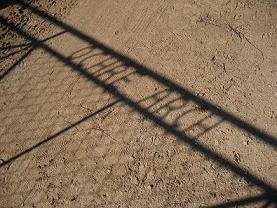
The last step in the name change process was to replace the lettering on the front gate. With the help of Ray and Rosemary Walter of Grenfell Steel Construction this is now complete ... as depicted in the attached photograph.

Friday, 28 July 2006

Ochre Archives Newsletter - Issue No. 2

Introduction
Welcome to the second edition of ‘Ochre Archives’. Thanks for your very positive feedback on Issue No. 1. We’ve included responses below to the various questions and suggestions made.

Responses to Issue No. 1 Feedback
How big is the property, “Ochre Arch”?
Ochre Arch covers 385 hectares (3.85 m sq metres), small by local standards. For the city based readers, this equates in residential housing terms to around 6,400 average building blocks. Looking at it another way, 400 ha equates to 4 sq km. Thus if the property shape was a perfect square there would be almost 8km of boundary fencing.

What are our core farm management plans?
Some readers thought we were actually running the farm ourselves. Our adjoining neighbours, Harvey and Jacquie Matthews, lease the farm and thus run the property within their total farming operations.

What pests do we encounter on the property?
What is considered a pest from a human perspective varies between individuals, locations and eras. Some of the things that were once or are currently considered pests locally (to the extent that people have historically taken or still take action to eliminate them) are:
Birds: Crows, hawks, eagles, magpies, galahs, sparrows, starlings and noisy minors
Animals: Rats, mice, foxes, kangaroos, emus, feral pigs, wallabies, possums, cats and goats.
Reptiles: Snakes and goannas
Insects: Flies, mosquitoes, ants, spiders, locusts, beetles, wasps, hornets, mites, lice, caterpillars and cockroaches
Invertebrates: Worms in livestock.
Plants: Bathurst Burr, Camel and Paddy melons, Saffron & Scotch thistles, Cape Weed, Blackberries, Box Thorn, Devil’s Claw, Clover burr, Paterson’s Curse, Eucalypt and Cypress Pine trees, Skeleton Weed, Black Oats, Bull Rushes, Barley Grass and Corkscrew Grass.

Aboriginal medicines information
Cheryl Kemp (well known Biodynamic Consultant) let us know that in the book, Emerald Downs (about a convict who lived with the Aborigines in late 1790s in NSW) it explains that Aborigines used honey to heal his burns, bark and clay for the wounds, fungal spores given orally to dull pain, and maggots to keep the wounds clean whilst healing.

Blog Site Establishment
Paul Griffiths (Holistic Management ™ Certified Educator) suggested that rather than send out Ochre Archives as a Portable Document Format (PDF) attached to the covering email we establish a blog site and provide those on the Ochre Archives distribution list with a link to the Newsletter. We’ve taken this advice on board. Phillip now has 2 sites: http://ochrearchives.blogspot.com/ and http://landhear.blogspot.com/. These blog sites contain additional information on our learnings and activities which readers might like to check out from time to time.

Findings from recent trips to the farm
Trees and Shrubs
We came across a young male flowering Drooping She-oak (Allocasuarina verticillata) as you can see in early July, and thank Toni McLeish & John Briggs from the NSW Department of Environment and Conservation for assisting with species identification.


Rock Formations

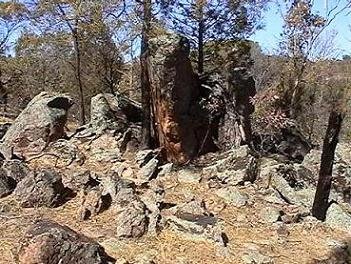
It turns out we have our own mini “Bread-knife” on the farm – for those familiar with the Warrumbungles:

Birds
Phillip’s Mum’s cousin, Robyn Walker wanted to know the species we’d seen to date so we went through our records and listed them all in the blog-site article http://ochrearchives.blogspot.com/2006/06/bird-species-seen-on-ochre-arch-to.html. Since then we’ve seen 2 more species, taking the total to 58 so far:
· Common Starling (Sturnus vulgaris)
· Noisy Friarbird (Philemon corniculatus)


Reptiles
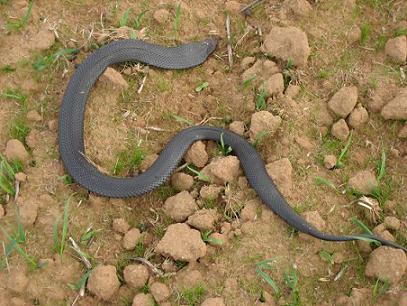
At Easter we came across a 1.4 metre Blue-bellied Black (AKA Spotted Black) Snake (Pseudechis guttatus) near the shearing shed, coiled up in a short rabbit burrow and a 1 metre example out in the open in the middle of the oat crop in mid-July. So one cannot assume all snakes hibernate during winter!

Native Animals

We came across a Lesser Long-eared Bat (Nyctophilus geoffroyi) on the floor of the shearing shed one morning and also saw a couple of Common Brushtail Possums (Tichosurus vulpecula) whilst spotlighting for nocturnal wildlife through some of the White Box country up in the hills .


Patterns

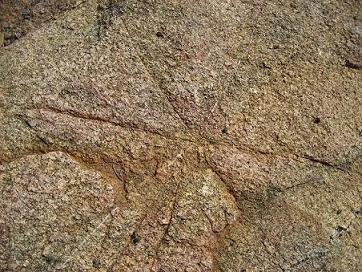
The design you can see in this photograph was created naturally during the formation and subsequent uncovering of this granite boulder. The area is approx. 1.5 metrea squared.


Experimentation
A few months ago we came across an eroded section of soil near a gate (high traffic area for stock and vehicles) that was approximately 300 mm (deep) X 800 mm (long) X 300 mm (across). We filled it with a couple of green Camel melon vines, minus the melons! The picture below was taken a couple of weeks ago, suggesting that the eroded area is well on the way to full recovery.

It is not clear whether using Camel melon vines (rather than some other vegetation) had an impact on the rapid repair – we have heard that the sap from these vines / melons was used by Aborigines to eradicate fungal skin ailments such as Tinea.

In Closing
Once again, feedback is most welcome, via email to pdiprose@optusnet.com.au. Stay happy and well.

Kind regards…

Phillip & Jan Diprose

Link to: Ochre Archives Newsletter - Issue No. 1

Link to: Ochre Archives Newsletter - Issue No. 3


Ochre Archives Newsletter - Issue No. 1

Background
In April this year Jan and I produced, in PDF format, Issue No. 1 of a Newsletter we titled Ochre Archives, which we emailed to a wide group of family and friends. Since then we have set up this blog site and are in the latter stages of finalising Issue No. 2, which will this time be circulated to most people via a link to this blog site - although we will still produce a copy in PDF format for our own purposes. Issue No. 2 makes references to the prior edition, so in the interest of continuity and ease of access for our readers we have reproduced the content of Issue No. 1 below.

THE FOLLOWING WAS WRITTEN IN APRIL 2006
Introduction
Welcome to the first edition of ‘Ochre Archives’, which aims to record and share discoveries and events connected with our farm “Ochre Arch” near Grenfell in New South Wales, Australia.
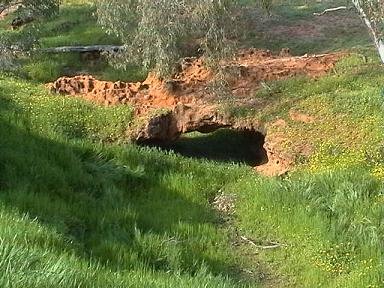
We recently changed the property name to Ochre Arch when we learned that Aborigines once mined ochre from under the natural ironstone arch in one of the creeks. Here is a picture of the arch:
We’ve owned the farm since late 2003 and had access to it through family since 1979. Despite many walks through the scrub and around the place we have yet to see it all given the size, terrain and vegetation. Every time we visit, without exception, we learn or observe something new or different. We figure if it’s exciting for us then it might at least be interesting to others, and felt a newsletter was probably the best way of sharing the information.
Hyperlinks have been included throughout the document, providing access to additional information for those who are interested.

Findings from the last trip to the farm
Trees and Shrubs
We found 3 Native Cherry or Cherry Ballart (Exocarpos cupressiformis) trees, and confess to never even having heard of them before. They are usually co-located with eucalyptus, and are parasitic. Unlike mistletoe they can survive if the host plant dies. European settlers used them as Christmas trees, and a web site we found suggests that Aboriginal use included:
· Sap - used as a snake bite treatment,
· Twigs - provided a tonic and astringent, valuable as a solution for stopping infection,
· Leaves - used to create a smoke for repelling insects during the summer months.
The web site also states: “Of interest, is the use by north eastern Australian aboriginals, of the closely related species Exocarpus latifolius (Broad-leaved native cherry). This plant had yellow fruit, which was again eaten when very ripe. However, its bark was soaked to provide a tonic for the sterilization of tribal women, no longer allowed to give birth due to tribal traditions.”

We contacted Sue Hudson (Sue is an Aboriginal archaeologist, and visited our farm in September 2005) for some additional thoughts on the Cherry Ballart. She confirmed much of the above and suggested caution in eating the fruit given that the Aborigines used it to induce abortions! Good advice, we reckon.

Mikla Lewis (a local resident with a deep knowledge of, and passion for, native flora and fauna) visited and pointed out many species of plants that we did not know the names of, including:
· White Box. (Eucalyptus albens) trees
· Bull-oak (Casuarina luehmannii) trees
· Drooping She-oak (Casuarina stricta) trees
· Currawang (Acacia doratoxylon) wattle
· Tumbledown Red Gum (Eucalyptus dealbata) trees
· Dwyer’s Red Gum (Eucalyptus dwyeri) trees

Rock Formations
It also turns out we have our own mini “Hanging Rock”, as you can see in this picture:

Reptiles
We spotted 2 young Eastern Bearded Dragons (Pogona Barbata) in different paddocks.

Birds
The following 4 new bird species were sighted, taking the total to 49 so far:
· Brown Treecreeper (Climacteris picumnus) – listed as ‘vulnerable’ on the NSW Threatened Species website
· Little Pied Cormorants (Phalacrocorax melanoleucos)
· Jacky Winter (Microeca fascinans)
· Zebra Finch (Taeniopygia guttata)

Water
Harvey Matthews (Harvey & Jacquie lease Ochre Arch) commented despite the fact that there has not been significant rain since last November the fresh water natural spring started ‘producing’ a lot more water about 1 month ago; presumably as a consequence of the 500 mm of rain that fell during the cooler months of 2005.

Patterns
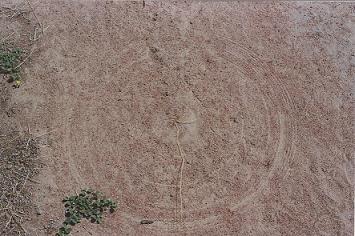
A single stem of grass on bare ground, assisted by wind, created this design. The circle is approx. 800 mm in diameter.

Native Animals
We spotted a large almost black Eastern Wallaroo (Macropus robustus robustus).

Experimentation
During the past year several people have suggested to us that they have had success in restoring bare ground and ‘filling in’ small gullies by placing ‘anything that was alive and is now dead’ (such a dead sheep, branches etc.) on the site.Near the cottage on the farm is a patch of bare ground on the edge of the creek caused, in part, about half a century ago when the top soil was pushed into the creek to create a bank for vehicles to cross. We’ve decided to try out the idea as you will see in the accompanying photo, and have been careful to make sure the dead branches are not in places where they would float and wash down the creek following downpours (potentially damaging fences). It will be interesting to see what happens. Not that we want this to happen, but it’s possible we may have created an ideal habitat for rabbits given they like both cover and adjacent bare ground.

In Closing
We welcome any feedback you might have via email to pdiprose@optusnet.com.au. Please also let us know if you do not want to receive future editions of Ochre Archives, or perhaps you want to visit the property (please - only when we are at the farm – this is for Health & Safety and Security reasons).

We hope this finds you happy and well.

Kind regards…

Phillip & Jan Diprose

Link to: Ochre Archives Newsletter - Issue No. 2

Link to: Ochre Archives Newsletter - Issue No. 3

Thursday, 22 June 2006

Protecting new concepts via patents

Earlier this morning I was talking to my mate, Ian, about a new idea for a business that I’d heard yesterday. During the conversation he mentioned that the Patent Office applies 3 key tests before registering any new concepts:
1. NOVELTY. How new is the idea?
2. OBVIOUSNESS. Is the idea blatantly obvious?
3. REDUCTION TO PRACTICE. Can you actually show how you have implemented an invention in a best form? If an invention cannot be actually "constructed" then it is not meant to be patentable.

Tuesday, 20 June 2006

Remote Area Power Supply systems

A good friend or ours, David, has been investigating Remote Area Power Supply systems and came across the Solar Online Australia website. I’ve had a good look at it and have to say that, ‘Yes’, I am very impressed. If they are capable of assembling a web site like they have (simple enough that even I can follow it) then I reckon they should at least be worth checking out by anyone considering buying and installing a system. They also sell small wind turbines and direct current water pumps. NB. I’ve no idea how their pricing or service stacks up.
The web address is http://www.solaronline.com.au/ and the business operates out of Warner’s Bay near Newcastle in New South Wales.

Sunday, 18 June 2006

Emu Eggs. A somewhat daunting Bush Tucker!

The emus (Dromaius novaehollandiae) on our neighbour’s place are currently laying eggs, in readiness for setting and raising the next batch of chicks. I found a clutch about 1 metre over our boundary fence and mentioned their existence the next day in town to Gaynor (the neighbour) who owns the emus, and was a little surprised when she invited me to take some as they had not yet begun to ‘sit’ on them and it would help her in keeping the number of birds to a reasonable level.
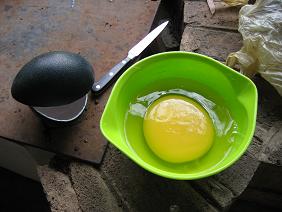
I ended up taking 3 eggs (leaving plenty) for the purpose of keeping the shells as ornaments and doing a taste test on at least one of them. The challenge was then to try and neatly halve the shells whilst leaving the yolks intact. After some deliberation I found one way of achieving the goal – purchasing a very fine blade for my 4” angle grinder, marking a straight line around the shell using a rubber band and some chalk, and carefully cutting just through (only) the hard shell and not the soft sack or membrane that surrounds the albumen and yolk. Once this was complete I used a knife to cut through the membrane, placing the HUGE egg contents in a bowl as depicted in the picture. A bit ‘touch-and-go’, but I got there. It was then necessary to remove the white membrane layers on the inside of the shell which was not that difficult. I decided the best way to cook one of the eggs was ‘scrambled’, and added a little milk whilst whisking – the same as for ‘normal’ eggs. This was the daunting part really as the albumen and yolk were so big compared to what I’d usually have a go at - equivalent in volume to about 9 conventional chook eggs.
So “What did it taste like?” I hear you say. It was no different to chook eggs, but the texture was slightly more viscous. Jan and Stuart also shared in the tasting, and there was still plenty left after the 3 of us were fed.
Michael Morcombe’s “Field Guide to Australian Birds” explains that emus are widespread throughout the Australian continent and in the wild tend to live in pairs or family parties of up to 12, averaging 1-2 km apart but much closer when conditions are favourable. They are migratory or nomadic, wandering in response to seasonal conditions and only gather in large numbers due to the existence of man-made barriers such as fences. The species is principally vegetarian but they will take some insects. In the breeding season the females make deep thudding drumming and booming noises; and the males (who sit on the eggs and raise the chicks) give low growls to communicate with the chicks.

Wallabies V England - "Where's G Smith"?

Earlier this evening Jan, John and I went and saw the Wallabies bring home an impressive 43-18 win over England in the second Cook Cup match of the Bundaberg Rum Rugby Series at the Telstra Dome in Melbourne.
What made the game even more interesting was that I was sitting directly behind one of the English support team, who was giving instructions directly to someone actually playing on field. We noticed that he had a folder on his lap that had a writing pad, with the top page clearly headed up as a ‘Check List” for the team. The dot-points on the left hand side were aspects the team had been instructed to watch out for with the Aussies, and on the right hand side were the English team’s tactics.
For once I happened to have my trusty digital camera and snuck in a quick snap of what we could see of the Check List (wouldn’t you!) – see the accompanying image. We all liked the 4th dot point which reads “Where’s G Smith”. What a game he had. I reckon they should have had “Where’s Lote Tuqiri” on the top of it. What an awesome game he had … making the English # 14, Tom Varndell, look silly until right at the end when he scored a consolation try.
A great night; and a great result!

Friday, 16 June 2006

Ochre Arch History Part 5 - The Hampton Era

During the past couple of months I’ve corresponded with Don Hampton and his son David, and have appreciated their generosity in passing on to me information about our farm whilst Don was the owner from 1963 (when he purchased it from Lindsay Causer) to 1978 (when he sold it to Roy and Jean Kelly). The main message for me from these interactions was the impressive amounts of improvement Don and the family made to the landscape during the period.
I’ve divided the information Don and David have given me to create this blog into 2 themes: Landscape Improvements, and Memories and Observations. For some readers it might help to reference the scanned image of the Parish Map I attached to the Ochre Arch History Part 2.
LANDSCAPE IMPROVEMENTS
Fencing
Don completed out a considerable amount of internal fencing on the property, including the construction of a new ‘east-west’ running rabbit proof fence from the western boundary (where the Frost & Diprose neighbouring properties met) to half way across the property along the border between Lots / Portions 42 and 60.
The strainer and some other posts were replaced, and old used wire was used to repair and rabbit proof the eastern (England) and southern (Livingstone) boundary along Portion 42.
The southern part of the western boundary fence on Portion 42 was not originally constructed on the official boundary line. Consequently about 20 acres of neighbouring “Roselea” was at that time within the fenced boundary of Ochre Arch. Don arranged for the boundary to be professionally surveyed prior to selling the place. A new boundary fence along the official boundary was constructed in 1982 by Bruce and Peter Diprose.
The main section of the sheep yards were built by Don, with the actual steel panel fabrication being carried out where the family resided, at “Glenowen” on the Henry Lawson Way. The sheep yard steel is boiler tubing from steam engines, which explains the neat bends on the ends of the pipes.
Don also fabricated (on “Glenowen”) and erected the main gate to the entrance of Ochre Arch. Kevin Huckel supplied the large steel tubes which were used as posts. These extend about three feet in the ground and are filled with rocks and concrete.
Dams and Contour Banks
Don and David Johnson (Marie’s brother) built the dam toward the top of the gully in the Plateau Paddock. David Johnson recalls that there was extremely hard rock not far below the original landscape level, which they used explosives to remove.
The Soil Conservation Service was commissioned by Don to put in all the contour banks and to dig the dam in the Contour Paddock.
Don had the use of the Clarrie Johnson’s (Marie’s father) D4 Caterpillar tractor for a month or so and used it to dig out rabbit burrows and to construct the low level contour banks in the north east corner of the Front Paddock and south-east corner of the Spring Paddock.
Springs and soaks
The spring near the north-western corner of the Spring Paddock always produced water but it was a very small hole and not practical for stock watering. Don, with the assistance of Bob Berry, dug a larger hole using a scoop and dynamite. Whilst they had been advised not to use explosives in case it altered the flow of the water, they did it anyway with no negative impact. The water flow was such that it ran across the road into the dam on the neighbouring property, “Pinnacle”, then owned by the Hunter family.
Don recalls the existence of two fresh-water soaks existing on Ochre Arch, both of which are still evident today. The first was located at about the mid-point and on the southern edge of the creek in the Contour Paddock, and the second was very close to the western boundary just to the south of the creek in the Front Paddock. He had intended scooping out the second one as he was sure it would have filled with water, and has no recollection of any other springs or soaks.
Clearing timber
The Native Pasture (or Back) Paddock was cleared of timber i.e. the trees were cut down and poisoned. Some of the stumps from this activity were still there when the property was sold. Trees were also cut down and poisoned along the eastern boundary of the Plateau Paddock.
Rabbit control
Rabbits were large in numbers on the place, and Don spent as much as half of his time getting them to manageable numbers. Aside from fencing, ripping burrows and poisoning, Don also used some ‘home-brew’ explosives to eradicate some of the larger warrens, accompanied by some (to use his words) “run-like-hell” moments creating a safe distance before ignition. Signs of this explosive and effective activity are still evident today on the top of the hill to the north east of the Plateau Paddock.
MEMORIES AND OBSERVATIONS
From Don Hampton
The names that the Hampton family gave to each of the paddocks on the farm, followed in brackets by the ones we use today, were Front (Front), House (House), Road (Contour), Spring (Spring), Clover (Plateau), Timber (Native Pasture), Hill (Lookout Rock), and Creek (Forgotten) Paddock. Jan and I have decided to call the Forgotten Paddock the Deep Creek Paddock from now on.
The dam in the House Paddock was the only one that held water for extended periods. During the 1968 drought all of the sheep were kept in the Contour Paddock and fed on wheat. Water was pumped into containers from the spring in the adjacent Paddock.
The shearing shed was used for shearing and crutching a few times but at that time, in Don’s words, “you had to be a weather forecaster because there was nowhere to shed the sheep” to keep them out of the rain (and thus the wool dry). It was just a shed with no skillion, and had a concrete floor which the shearer’s didn’t go much on. The old engine in the shed at the time used to “go like a rocket”.
Don’s 1964 financial accounts show the farm as being valued (at cost) at 11200 Pounds 12 Shillings and 1 penny, and comprising 953 Acres.
Don used to camp in the back of the Ute on the weekends with his sons, David and Paul, stoking fires and burning timber. There was also a time when the whole family was on the property and the vehicle bogged - and they all walked to “Rutland” to get help.
Whilst this is not directly related to the history of Ochre Arch, it is worth noting that Don’s great grandfather came to Australia from the Isle of Man. He had a small farm behind the Grenfell cemetery (exact location no known), and drowned in Vaughn's Dam (down near Lawson Park) carting water with a horse and Furphy tank on skids.
From Marie Hampton
One of the old Parish maps I have shows the existence of a ‘Salt Shed” near the spring. Marie remembers seeing this shed (and that it was made of galvanized iron) during a visit to the farm in about 1938, when the property was owned by Fred Bokeyar (pronounced “Bokai”).
From David Hampton
David recalls that he and quite a few mates spent many weekends playing on and around the arch over the creek while his father was eradicating rabbits or clearing dead timber; and how fearless we (David, Craig Livingstone and I) were riding motorbikes from “Roselea” up over the steep hills into the back of Ochre Arch.
The remains of an old header are near the creek in the Spring Paddock. For those who may not be aware … if you selected low range on a Massey Ferguson tractor with the motor stopped there is no engine braking, even though it is in gear.
David recalls that one night when he and Paul where camping out with their Dad on the farm Don pointed out to them how on a clear night the lights of Forbes and Parkes can be clearly seen from the top of Lookout Rock.
Link to Ochre Arch History Part 1
Link to Ochre Arch History Part 2
Link to Ochre Arch History Part 3
Link to Ochre Arch History Part 4

Thursday, 15 June 2006

Checking out the night-life

Jan and I were on the farm last week and one evening did a bit of spotlighting through some of the White Box country up in the hills, looking for nocturnal birds and tree dwelling animals. We came across two Common Brushtail Possums (Tichosurus vulpecula) in different spots, which was a bit of a thrill given it is so dry … and we’d never seen them on our place before. These are the same species of possum that are in plague proportion following their introduction to New Zealand and the locals have found it necessary to introduce programs to keep numbers in check.
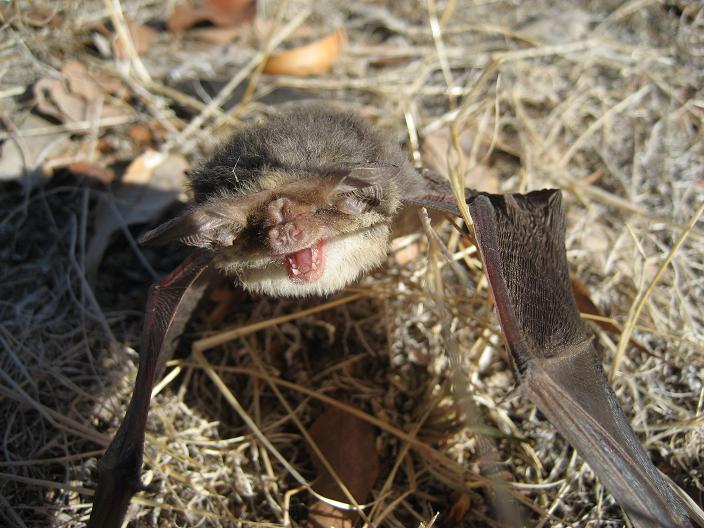
At about 2 am that same night we were woken by the scratching and muffled squealing of a small bat that had managed to get itself caught between one of the windows and its cover. I managed to free it by removing the cover. In the daylight I found a similar (and maybe even the same) bat alive but on its back on the floor of the shearing shed, which is located about 75 metres from the house. After taking a few photos, 2 of which are part of this blog, I placed the bat on a sheltered branch of a tree and saw no more of it again.
Yesterday I emailed a couple of the photos to my good friend, Toni McLeish who works for the NSW Department of Environment and Conservation (where she coordinates the activities of the Grassy Box Woodlands Conservation Management Network) to see if she or someone she works with could identify the species. She responded quickly advising it was a Lesser Long-eared Bat (Nyctophilus geoffroyi).
Toni explained that “the identification features are the long ears (of course), the bump above the nose which has a "Y" groove and silver belly fur; and that they are not rare but are special, and do like houses and curtains in particular.” The book we have titled “A Field Guide to Mammals of Australia” by Peter Menkhorst and Frank Knight states that Lesser Long-eared Bats are one of Australia’s most widespread and abundant mammals, common over most of the mainland except for Cape York and the east coast of Queensland.

Tuesday, 23 May 2006

Introducing Exotic Species to the Environment - A Ballad

A couple of years ago Jan and I were going through some of my father's papers and found a very old typed copy of the ballad "Grimbles and the Gnad" which was written by C J Dennis and first published on Page 18 of The Weekly Times Annual on 4 November 1915. Dad had obviously taken a real liking to the story - and after reading it I can understand why.
The main intent of the story, as I see it, is to highlight in a humorous way the dangers of introducing exotic (or non-native) organisms to an environment in an attempt to control some other organism that is considered a pest for whatever reason.
The web address of an internet site that holds a copy of "Grimbles and the Gnad" is http://www.middlemiss.org/lit/authors/denniscj/backblocklater/grimbles.html
Estimated reading time is 5 minutes as it takes a little while to get the hang of the lingo. Enjoy!

Sunday, 21 May 2006

Aboriginal approach to bushfire control

In response to my last blog (which mentions the Wiradjuri people and fire), Col Freeman sent me though a link to a lengthy but fascinating article written by George Main and published on the La Trobe Library website during October 2004 that in one section describes the technique used by the Wiradjuri people to control bushfires. Thanks for sending the link through, Col.
Those who would like to read the article can access it at http://www.lib.latrobe.edu.au/AHR/archive/Issue-August-2004/main.html

Ochre Arch History Part 4 - Pre European Settlement

Pre arrival of the Aborigines
There is general consensus that the Aborigines arrived on the Australian continent somewhere between 40-60,000 years ago and that during this period there has been a major decline in the species of very large mammals, or megafauna. There is great debate as to the cause of the extinction of these megafauna species, ranging from the impact of early people of Australia hunting them to extinction and / or using fire to alter the environment, to significant climatic changes over the period (especially a very intense dry spell around 26,000 years ago), through to the effect of new animals coming into Australia as we drew ever closer to south-east Asia (including disease or infestation bought along with the invading species).
Allan Savory in his book “Holistic Management – A New Framework for Decision Making” (ISBN 1-55963-488-X) makes the following comments on Page 6. “By the time humans acquired the use of fire, and our technology had grown sophisticated enough to enable us to reach and settle new continents or isolated islands, we were capable of inflicting enormous damage. Within 400 years of their arrival in New Zealand, the Maori had exterminated nearly all the flightless birds, including 12 different species of the giant (550 pound) moa, and decimated much of the seashore life. Following the arrival of the Aborigines in Australia … over 80 percent of the large mammalian genera became extinct. The fires deliberately set by the Aborigines when hunting, or to limit the extent of uninhabitable rainforest, led to a dramatic increase in soil erosion, the abrupt disappearance of fire sensitive plant species, and a dramatic Increase in fire-dependent species, such as eucalypts. In North America, over 70 percent of the large mammalian genera became extinct following the arrival of Native Americans around 12,000 years ago.”
I have included the above purely to make the point that the environment on and around Ochre Arch has changed (possibly) quite dramatically throughout the millennia. I am not attempting to attribute blame for this change. Let's not forget that since the arrival of European settlers there has been a decline of over 25 % in the number of ALL mammal species in Australia.
For those interested in learning more about the species of Australian megafauna that are now extinct I strongly recommend you spend a few minutes checking out the web address http://abc.net.au/science/ausbeasts/factfiles. Imagine having 2 tonne wombats and marsupial lions roaming around!
Local Aborigines
Ochre Arch is in the South West Slopes region of NSW, and from an indigenous Australia perspective falls within ‘Wiradjuri country’. Wiradjuri refers to the Aboriginal language that was, and is still, spoken by the various family or kinship groups throughout the region and is said to mean ‘people of the three rivers’; with those rivers being the Macquarie, Lachlan and Murrumbidgee. I know little of the history of the Wiradjuri people but understand the land area they occupied and their impact declined significantly between 1830 and 1850 in connection with the territorial spread of the early settlers. This period ties in with the establishment of the Pinnacle Run mentioned in a prior blog. The Aboriginal communities nearest to Ochre Arch that I am aware of are at Forbes and Cowra.
We have found a couple of artefacts on Ochre Arch, and as I’ve mentioned in another blog we renamed the property from to Ochre Arch following a visit from Aboriginal archaeologist Sue Hudson in September 2005. Sue discovered that the natural ironstone arch in one of our creeks had been mined by Aborigines for ochre.
I contacted Sue Hudson to find out a little more about the Wiradjuri language. She informed me that:
1. 'Wiradjuri' is still spoken and it is offered a language course out of the Australian National University in Canberra.
2. 'Wiradjuri' refers to a language group. This means that all of the people in the area spoke it but it differed from place to place in that you can understand what they are saying but it sounds different. Similar to what occurs in the counties of England; for example Yorkshire compared to London.
3. Language groups are distinct but in areas where there are adjacent language groups bits of each language can be understood by neighbours, For example, the English spoken by the English from England compared to Welch from the Welch in Wales. Some neighbouring Aboriginal language groups are Wiradjuri, Wongarbon and Gamaroi.
4. Aboriginal groups are not referred to as tribes - there are no tribes as such. There are family or kinship groups within each area. For example, those living around Grenfell would be related to one another, some close, some distant. Their marriage partners came from groups such as, say, Peak Hill, Cowra or Condobolin that would meet at social/ceremonial occasions. Their system of who could/couldn't marry is very strict and is called 'moieties'.
5. An excellent publication to learn more about Aborigines is "The World of the First Australians" by RM & CH Berndt.
When Jan and I were visiting Wallace Rockhole in the Northern Territory recently the local tour guide, Ken, made a comment about land connection and Aborigines that is worth mentioning. Most of us who live in Australia speak of ‘owning the land’ whilst the Aborigines believe they ‘belong to’ the land. A very different perspective indeed.
Link to Ochre Arch History Part 1
Link to Ochre Arch History Part 2
Link to Ochre Arch History Part 3
Link to Ochre Arch History Part 5

Saturday, 20 May 2006

R M Williams' Autobiography

Whilst waiting at Alice Springs for our flight back to Melbourne on 13 May 2006 following our 5 day Sahara Adventures red centre tour I bought a copy of R M (Reginald Murray) Williams autobiography (ISBN 0-7251-0753-7), and finished reading it last night. What an amazing read about an amazing bloke! Essential reading in my view for anyone seriously interested in the study of the development of primary industry in Australia. I’ve recorded below a just few of the things that I learned and want to remember or views he expressed that I think are worth sharing. What’s below is just the ‘tip of the iceberg’ of what his book has to offer.
How Aborigines in desert areas made fire
RM spent a great many years in direct contact with Aboriginal people, meeting some who he believes had no prior contact with ‘the white man’. He held them in high regard, recognizing their amazing skills, and deep understanding of the environment in which they lived. On page 28 he explains how they made fire:
“To make fire they shredded dray kangaroo dung into a crack in a fairly substantial piece of wood, then two of them would rub the hard burnished surface of a spear-thrower across the crack, causing smouldering material from the log to fall into the tinder in the crack. When enough had gathered they tipped it out into a bunch of dried grass, waiving this into the air to fan it into a flame. Thus they seemed to make fire without much effort; it wasn’t quite as easy as striking a match but it took only a few minutes.”
Aborigines and religion
The core content of RM’s autobiography is obviously his recounting the major events of his life, but he puts forward his thoughts on Australia and the world at large, including the subject of religion. On page 29 he shares what he comments on the religious beliefs of the Aboriginal desert people he met during the 1920’s and beyond.
“These desert people lived in a state of mental contentment. I attribute this to the centuries-old practice of a religion that was not a spiritual seeking but rather a total immersion in the mysticism that provided a pragmatic solution to any problem of survival. Whereas my needs for spiritual satisfaction included a promise of change, a hope for something better, the Aborigines – and in fact most Stone Age people – live and die content in the complete religion that explains an environment they do not want to see altered.”
Aboriginal mission without white man interference
In about 1934 RM received a call from Dr Charles Duguid who he describes on Page 64 as ‘a surgeon with considerable care for the Aborigines.” One outcome of this contact was the formation of a Committee (with RM as a member) which established a medical mission for the Aborigines at Ernabella in the Musgraves, and Dr Duguid was “determined it should be one in which the natives were left to follow their own way of life … where they would have time to adjust to the changes that were coming whether they liked them or not, and thus have a chance of survival. The most basic feature was the concept of freedom – no interference with tribal customs, no compulsion and no imposition of white man way of life”. On Page 66 RM goes on to say “Ernabella Mission was to become a big factor in preserving the state of Aborigines in the Musgraves, and it still stands as something of a bastion against white intrusion.”
Discipline and Aboriginal children
On Page 66 RM talks about how the Aboriginal people did not disciplined their children. In his words “there was no need, for the struggle of life itself was a discipline. Long marches on a hungry belly, fierce laws that demanded death if broken, skill to kill as the essential element for survival, and a surrounding of enemies produced by a society of people made honest by necessity.”
The Bushman’s Handbook
On Page 68 RM talks about how he wrote and published The Busman’s Handbook, which was designed to “assist young bushmen and others who wanted to make things of real worth and serviceability: saddles, boots, stockwhips, belts – anything that could be made of leather, beginning with the tanning of the hide.”
RM on the behaviour of modern day politicians
On Page 73 RM talks about his involvement in the formation of the Australian Rough Riders Association and goes on to say how “In this organization I made many life long friends, fellows who have proved themselves to be champions in every way, and when I hear our politicians abusing each other in Parliament I recall that none of our members would speak in such a manner unless he were prepared to do battle on the grass.”
Man’s responsibility for the environment
On Page 127 RM explains: “The essential difference between man and animals is that man has a … quality of being able to change his environment. When he plants a seed he does so with the knowledge that some day it will become a tree, and that the tree will provide shade or sustenance. He plants a garden with the knowledge that some day it will give him pleasure. He preconceives the outcome of his activities. To carry this argument to its logical conclusion we must arrive at the decision that we are responsible for the environment in which we live.”
Cattle and salt licks
On Pages 140 and 141 RM explains how he used to use salt licks as a mechanism to integrate his own cattle with those they were wild, and in this way he was able to muster most that were on the country he had legal access to. It was toward the end of the drought years of the late 1960’s that the Queensland Department of Primary Industry “had discovered that cattle given licks of a mixture of molasses and urea and phosphoric acid maintained health and condition even though the available grazing was extremely poor, and they would ingest materials they would normally ignore, such as wattle and whitewood leaves, and prickly pear.”
Adaptation of the Pioneers to the environment
On Page 183 RM sets out many of the ways in which the Australian Pioneers (especially the cattlemen) developed methods and attire for survival. I’ve personally worn elastic sides boots from the time I was very young, and until reading RM's Autobiography confess that I was not aware of the real reason they were invented. As RM explains, the cattleman’s “boots were made easy to get on, because of the need for fast action if cattle rushed in the night.”

Monday, 15 May 2006

Our Red Centre Tour - May 2006 - Itinerary

Jan and recently traveled to the ‘Red Centre’ of Australia for a 5 day camping tour with Sahara Adventures. What follows is the base itinerary. Obviously we have many more memories and photographs of our trip which we’ll share with friends over time.

8th May 2006 Melbourne to Ayers Rock
We caught the 08.45 flight from Melbourne to Ayers Rock Airport and then the courtesy bus to the Outback Pioneer Hotel at Ayers Rock Resort. At 13.45 we were picked up by Sahara Adventures. There were 19 people in all on the bus; including the Tour Guide, 14 people for the 5 day Tour and 4 doing the 3 day Tour. Lunch was at the Ayers Rock Sahara Adventures permanent campsite. Our group then went to Kata Tjuta (The Olgas) where we did the Walpa Gorge walk. From there we drove to the public viewing area at Uluru to watch the sun set before returning to the campsite for dinner and sleep.

9 May 2006 Uluru to Kings Creek Station
We reached Uluru before the 07.12 sunrise, with our Tour Guide having driven us around the entire base beforehand. Phillip and 5 others climbed Uluru, whilst Jan and the rest of the group walked the 9.5 km around the base of the Rock. After all gathering at the vehicle in the car park for morning tea, we did the Mala walk with our Tour Guide.
It was then back to the campsite to have lunch, pack up and hit the road; stopping first at Ayers Rock Resort, Yulara to check out the shops while the vehicle was refueled.
We traveled to Kings Creek Station via Lasseter Highway and then Luritja Road, stopping on the way at Curtin Springs Roadhouse (has a small native bird aviary) for fuel, then Mount Connor Lookout (Mount Connor is a large flat topped hill 3 times as big around as Uluru at 27 km); and off to the side of Luritja road at one point to collect firewood, arriving at the Sahara Adventures King Creek Station permanent campsite for the night. Just prior to dark Jan and I did the 35 minute helicopter flight over Kings Canyon and Petermann Pound. Our Tour Guide cooked dinner using camp ovens.

10 May 2006 Kings Creek Station to Glen Helen
At 06.45 we were all packed up and on the road to Kings Canyon. Most of the group (us included) did the 4 hour walk around the canyon, stopping briefly en-route for morning tea at the Garden of Eden. The rest of the group walked up and back along the base of the canyon. After refueling at Kings Canyon Resort we headed along the Mereenie Loop for about 10 minutes and pulled off to a designated stop at the top of a ridge for a picnic lunch.
After lunch we continued along the Mereenie Loop. We saw evidence of the Mereenie Oil and Gas field off to the right at one point, proceeded through Gardiner Range where we had an unplanned stop allowing some of us to photograph some wild horses, and another to ascertain the source of a new vehicle noise just forward of the left hand rear wheel, passed the Aboriginal Mission near Katapata Gap, and turned left along Route 2 toward Glen Helen. We saw Goss Bluff meteor crater from a distance off to the right and stopped for a break at Tylers Pass lookout where a group photograph was taken. On arriving at Glen Helen (16.45) we stopped at the Hotel while waiting for the other Sahara Adventures 4WD vehicle to arrive and take those who had completed the “Sahara Adventures 3 day trip” with us back to Alice Springs. It was then on to the Sahara Adventures permanent campsite to unpack, have dinner and sleep. During the wait for the meal to cook the ‘blokes’ went to the pub for an hour or so.

11 May 2006 Glen Helen to Wallace Rockhole
After breakfast Jan and I and another couple walked across the river to the mouth of the Glen Helen Gorge to see the water hole and take some photographs. The group was ‘on the road’ by about 08.30 with the first stop being the Mount Solomon lookout near Glen Helen. From there we went to Ormiston Gorge, with about half the group (us included) doing the 2 hour walk with our Tour Guide and the others walking up and back along the bottom of the Gorge. Our Tour Guide cooked hamburgers for lunch on one of the gas barbecues at the camping area.
After lunch we proceeded east along (Albert) Namatjira Drive to Ellery Creek / Big Hole where we spent some time relaxing in the sun near the edge of the water hole. I headed off on my own and climbed part way up the ridge behind the waterhole to explore the cave that can be seen from the edge of the water hole.
It was then on to Wallace Rockhole. On the way in to this ‘dry’ Aboriginal community we were pulled up by the Police who checked to make sure we were not bringing alcohol in to the area. We stopped at the General Store which is run by ‘Ken’ who also happens to be the key tourist person for the community. After leaving our gear in the tents at the Sahara Adventures permanent campsite Ken took us all on a drive/walk up to the Wallace Rockhole while our Tour Guide stayed behind and started preparations for dinner. Ken shared some excellent information with us about the Aboriginal people and concluded the tour by giving us access to the Arts Centre where many of us purchased locally manufactured items. After dinner we all talked for quite some time around the camp fire.

12 May 2006 Wallace Rockhole to Alice Springs
We were on the road by about 06.45. First stop was at the (Albert) Namatjira Monument on Larapinta Drive, then on to Hermannsburg where we dropped off the trailer lightening the load for our first bit of real 4 wheel-driving out to the Finke Gorge National Park where we saw the Kalarranga Lookout and then moved on to Palm Valley to see the ancient palms and rock formations that abound in the Gorge.
After a walk that takes about 1.5 hours we enjoyed a picnic lunch at one of the eating and toilet block areas in the National Park before returning to Hermannsburg to pick up the trailer / check out the local store and head east along Larapinta Drive toward Alice Springs. We spent a couple of hours at Standley Chasm, and proceeded on to Alice Springs were our Tour Guide took us past a couple of tourist spots and dropped each of us at our accommodation locations. Jan and I stayed at the All Seasons Diplomat Motel. After walking around Todd Mall, we enjoyed a drink at the Todd Tavern and some shopping before dining at the Overlanders Steakhouse.

13 May 2006 Alice Springs to Melbourne
After breakfast we did the “Alice Wanderer ‘Hop on – Hop off’ Alice Explorer Town Tour”, catching the bus out the front of our Motel at 08.50. The tour duration was 1 hour 10 minutes and the trip took us past the Todd Mall, Old Telegraph Station, School of the Air, Anzac Hill (the tour includes an allowance of a couple of minutes to walk around and take some photographs), Panorama Guth Art Gallery, Royal Flying Doctor Base, Alice Springs Reptile Centre, Alice Springs Cultural Precinct (including the Museum of Central Australia, Aviation Museum, Araluen Art and Sculpture Centre, Historic Cemetery [with the grave for Albert Namatjira]), Road Transport Hall of Fame, Old Ghan Train, Date Gardens and the Olive Pink Native Species Gardens.
When we finished the tour we packed up our bags at the Motel and took a cab to the Airport for our 11.30 flight back to Melbourne, arriving 14.25.

Tuesday, 2 May 2006

Ochre Arch History Part 3 – Developments & Events

In this article I briefly outline some of the events and developments which significantly impacted those living in the Pinnacle area:
1860’s Pinnacle was the site of a police Barracks in the hunt for bushrangers Gardiner, Omeally and Hall.
1880s Early in the decade there was an influx of settlers from Victoria and they took up all land available for selection on “Bogolong run” in what is known as the Piney Range area. The word ‘Bogolong’ means “bulldog-ant” in Aboriginal language.
1882 EHK Crawford commenced erecting the Pinnacle homestead (75,000 bricks!)
1888-9 4 reasonably local Hotels were in operation:
* Selectors Return Hotel at Piney Range - Elizabeth Butler proprietor
* Nags Head Hotel at Nags Head Bridge - William T Burrett proprietor
* Welcome Hotel at Wheoga - August Brenner proprietor
* Cricketers Hotel at Bogolong - John Bolton proprietor
1889 Part resumption of “Pinnacle run” (Refer OA History Part 2) – to the 4 Good brothers
1908-09 First telephone connection - to the new Grenfell exchange
1912 Pinnacle station, then 21,000 acres, was further ‘cut up and sold’ for Closer Settlement. Messrs Murray and Warren from South Australia bought the 6000 acre (approximately) homestead block at £6-10 per acre. The rest of the property was disposed of in smaller areas.
1916 5,811 acres of Pinnacle were resumed for Soldier Settlement, making it the first (along with Baerami and Manus estates) property ever resumed for this purpose. In October 1917 it was reported that 9 soldiers were successful in the ballot, with the larger homestead block of 1,267 acres going to Victor Crommelin.
1918 The Forbes-Stockinbingall rail line was officially opened in, giving settlers a closer outlet to rail at Garema and Wirrinya for their produce. The settlement had got underway properly - the first, and biggest of its kind in NSW. There were 6 gangs of fencers, four clearing gangs, and six tank sinkers working in the area in August 1918 and some new houses had been erected and bridges installed.
1919 By February the settlers had arranged for contractor Downey to build Pinnacle Hall - opened in March.
Link to Ochre Arch History Part 1
Link to Ochre Arch History Part 2
Link to Ochre Arch History Part 4
Link to Ochre Arch History Part 5
I invite / welcome comments on when the following took place:
* Connection of mains power – Today the charge per km of installing poles etc is around $35,000 per km.
* Local roads being made accessible in all weather
* Upgrade of telephones away from party lines

Author Anthony Trollope - Some trivia

In my last blog I mentioned that during the 1870s Frederick Trollope, son of English novelist Anthony Trollope, owned "Mortray Station" which adjoined "Pinnacle run" to the east.
Jan studied Anthony Trollope's book, 'The Warden', when at University and still has a copy of it. In the Introduction section of The Warden it quotes Trollope's biographer, Michael Sadleir as saying the following about him (in part) "It is true that his flavour is as agreeable to contemporary mentality as it was repellent to the eighteen-eighties; that his candor and his lack of afectation are grateful to an epoch which inevitably is an epoch of reaction from elaborate trifling". I really needed to know that!!
Anyway, Anthony Trollope was an extremely prolific writer of great fame and is also attributed with inventing the famous pillar (red mail) boxes in the United Kingdom. Wikipedia has a detailed write up on Anthony Trollope at http://en.wikipedia.org/wiki/Anthony_Trollope#Biography

Ochre Arch History Part 2 - Out of 'Pinnacle run'

In this article I share information about the development of the local area through to the creation and beyond of ‘Ochre Arch’ (previously ‘Cleveland’) as a distinct property. There are gaps, but this is what I have at present.
Ochre Arch is in the Land District of Grenfell and was originally part of “Pinnacle run”, first taken up by partners Graham and Croker in about 1839. The term ‘Pinnacle’ is a reference to The Pinnacle – the highest point in the northern part of the Wheoga range.
Graham had been an overseer at Burrangong Station, Lambing Flat (now Young) for a Mr. White. The Gazette of 1848 lists “Pinnacle run” as consisting of 26,880 acres, with Mr. F Hull then listed as the owner. Rodger Freely had “Pinnacle run” in 1854.
The town of Grenfell was gazetted in 1866, and its early wealth and population came from gold mining.
“Mortray Station” adjoined “Pinnacle run” to the east and belonged to Frederick Trollope (son of the author, Anthony Trollope) in the 1870’s. Later it was owned by J.L. Waugh and Little, and soon after “Pinnacle run” and “Mortray Station” came under the one ownership. The combined properties of approximately 67,000 acres were advertised for sale in 1878. It is possible the purchasers were the New Zealand Land and Finance Company, but whoever it was appointed Ernest Henry Kinleside Crawford as Manager and he immediately started clearing and fencing the country.
In 1898 some of “Pinnacle run” was resumed. The exact area involved is not known although some documents suggest it may have been around 6,000 acres. About that time the 4 Good brothers from Victoria took up the properties Wilga, Rutland, Warburton (by Thomas Mark), and Cleveland (by William George).
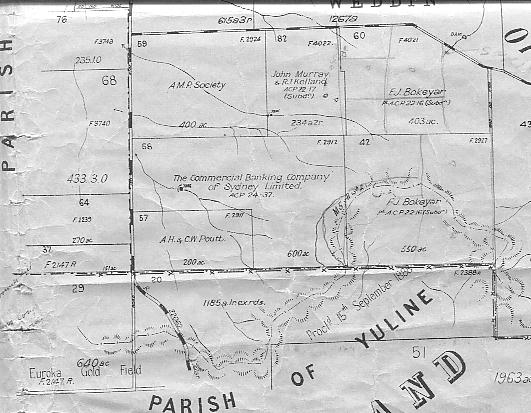
When William George Good took up “Cleveland” it was originally 1,587 acres and some of the documentation suggests that a CL (Conditional Lease?) was registered in 1899. The Parish of Maudry maps show that the property was made up of four Portions which appear in the accompanying image – going from west to east they number 59 (400 acres), then 82 (234 acres), and then 60 (403 acres), and from there south to 42 (550 acres).
In 1909 it was reported that William had planted 200 acres of wheat and was clearing more land.
The Grenfell Historical Society papers state that William George Good “… sold out to the Stein brothers sometime before 1914 and it appears that Mr. George Stein took it over about 1920. George Stein sold out here in 1926 and it passed through various hands …” One of the undated Parish of Maudry maps which was clearly issued after 1922 shows that at that time WG Good still owned Portion 59. The other 3 Portions had transferred to Richard John Kelland & John Murray in 1922 – Portion 82 under a Conditional Purchase, and Portions 60 and 42 under an Additional Conditional Purchase. Another later Parish of Maudry map (which the image above was taken from) suggests that at one point W G Good owned Portion 59, R J Kelland and J Murray owned Portion 82 and F J (Fred) Bokeyar owned Portions 60 and 42. One of the title deed copies suggests that FJ Bokeyar purchased Portions 60 and 42 in 1934 from Messrs Kelland and Murray, and the transaction was in fact a ‘sale-leaseback’.
From 1934 on “Cleveland” has constituted only Portions 60 and 42 in the Parish of Maudry. It’s interesting that two owners over time saw fit to retain the most western and arable Portion of the property they owned at the time of initial sale.
Link to Ochre Arch History Part 1
Link to Ochre Arch History Part 3
Link to Ochre Arch History Part 4
Link to Ochre Arch History Part 5

Ochre Arch History Part 1 – Introduction

I’ve decided to write and publish a series of blog articles that outline the history of the property that Jan and I own. The main sources of information include copies of papers prepared by members of the Grenfell Historical Society in 1967 (kindly provided to me by local resident, Ed Livingstone last month), copies of other documentation that my father, Bruce, had assembled over the years (including copies of old Parish of Maudry maps, title deeds and aerial photographs), discussions with some of the local residents such as Ian Pitt and Harvey Matthews, and accessing some web sites.
The frustrating part of researching anything is that the more one learns the more one wants to know. Consequently I’ve created a separate Word document listing the major questions I still have and in time will hopefully get some of them answered. From the perspective of the blog articles this means I may make later revisions.
In the interest of trying to maintain some level of personal sanity I’ve elected NOT to convert land areas from acres, to hectares. Readers can do this by multiplying the acre figures I quote by 0.404685642. Or as a rough and ready guide, you could simply divide the acres figures by 2.5.
In developing the property history I’ve also learned quite a bit about some of the neighbouring properties. Where I mention these properties it is only done to give context to how our own property and the local community developed.
Link to Ochre Arch History Part 2
Link to Ochre Arch History Part 3
Link to Ochre Arch History Part 4
Link to Ochre Arch History Part 5
Feedback is most welcome, and if you’d like to make a comment it’s a simple as clicking on the ‘comments’ link and following the prompts.

Monday, 1 May 2006

In response to Griffeaux’s comment on my last blog

“Griffeaux” made the following constructive comment of my Technology and Lamb Marking blog of 30 April 2006 “Phil, I'd be interested in your comments regarding the economic gains as a result of each of your headings under Technology and Lamb Marking. Also, what environmental gains are made as a result - and, you might ultimately respond on the social impacts of each activity - both short and long term.”
In response:
I’m going to make the assumption that there is not an implied objection to the farmers raising animals for use by humans for food and clothing, and consumers using/consuming such products.
From an economic perspective … each of the activities are undertaken on the basis that “prevention is better than cure” and to a certain extent "short term pain for long term gain" (a bit like getting ones tonsils removed!). For example, the marking process acts as a deterrent to stock thieves and simplifies the process of returning stock if they happen to accidently get out on the road or are stolen and recovered. Castration has an economic benefit to the farmer in that the consumer is prepared to purchase mutton from wethers, where many do not like the taste of the meat from mature / aged rams. I could go on. Oh, and by the way, I read recently that wool constitutes 2.3 % of global fibre consumption, reduced from 4 % in 1999.
From an environmental angle ... some could argue that castration prevents the natural formulation of male only flocks ... in turn reducing the hormonal diversity within an overall flock. Reduced fly strike makes life more comfortable for the sheep and the human carers, but does it reduce the food source for natural predators of flies! Of course the bigger issue from an environmental perspective is the decision making process around how the flocks are managed, and lamb marking is only a miniscule component of this.
From a social angle some will argue that lambs should not be ‘marked’ (in the broader definition) as some of the activities are cruel and that the animal suffers stress. Let’s not kid ourselves; the lambs do feel pain – especially from the tail docking. No doubt there have been scientific tests done that describe the intensity and duration of this discomfort. From my own observations most lambs seem to go straight back to feeding within a short period after marking process is concluded, and after 24 to 48 hours seem to be bouncing around the paddock with the same level of vigor as before the procedure. Against this is the chronic suffering that can occur from fly strike – and hear I’ve seen sheep that have had the walls of their stomachs with holes in them made by the activities of the maggots. Not pretty at all. For those that have not seen lambs marked the period of time an animal spends in ‘cradle’ restrained is only minutes. Some of the other social benefits of the marking process include product quality (from being able to trace back to individual consumers) and productivity (through improved animal health and tracking of individual animal performance.
One of the activities I was responsible for when helping my wife's brother with the lamb marking was attaching the ear tags to the ears. As I attached each ear tag I couldn't help but think how many of the human race front up for piercing in all sorts of places. Bazaar really!
To have your say, click on 'comments' below and follow the prompts.

Sunday, 30 April 2006

Technology and Lamb Marking

A couple of weeks ago I helped my wife’s brother ‘mark’ some of this seasons lambs. What follows gives the reader an understanding of what can be involved, and also highlights some of the technological and regulatory changes that have been introduced over the years.
The activities involved in marking lambs varies widely between livestock breeders but in the vast majority of cases it includes (at least) the application of some permanent ‘mark’ on the lamb this signifies ownership and removal of the animal’s tail.
The list (that comes to my mind) of possible activities during ‘marking’ is:
* MARKING – A small piece of the lamb’s ear is removed using registered (to the owner) design marking pliers to allow future identification. Males are marked in their left ear (right ear when looking at the sheep face on) and females in their right ear, enabling easy sex identification during subsequent handling (such as sorting or drafting). Some farmers also remove small pieces of the ear to signify the lamb’s year of birth. Recent legislation in NSW makes it compulsory that a manufactured ear tag is attached to an ear, identifying the owner and year of issue (different colours). The legislation does not remove the requirement to mark the ear via the marking pliers and thus the ear tag requirement is additional rather than a substitute. Some breeders use more sophisticated identification techniques such as technology readable micro-chips and bar codes enabling record keeping at individual animal level.
* TAIL DOCKING – Tails are removed to reduce the likelihood of fly strike around the base of the tail and reduce the time and effort in shearing (wool removal) the animal. Removal methods include cutting with a knife, application of a small rubber ring (cutting off the circulation and in time the tail falls off) and cutting with a hot (gas fired in most cases) knife which cauterizes the wound (eliminating blood loss and speeding recovery).
* CASTRATION – The testicles are removed or deadened to prevent the selected males from breeding, creating wethers. Doing so also makes handling of the flock easier through reduced animal fighting and avoids the meat becoming too ‘strong or gamy’ in flavour. Removal is by using a knife to remove the end of the scrotum and then manually extracting each testicle with a pair of specially designed pliers; although in days gone by the person performing the procedure would use his or her teeth. Many farmers these days prefer to place a small rubber ring over the entire scrotum using a specially designed tool, cutting off the circulation and in time the scrotum and contents fall from the animal.
* MULESING – Some breeders of merino sheep have the skin around the lamb’s rear and in part down the back legs removed using shears to reduce the risk of fly strike. This practice is under fire from the US based organisation, People for the Ethical Treatment of Animals (PETA), on animal welfare grounds. Australian Wool Innovation is responsible for developing a strategy acceptable to both PETA and the industry.
* PEST & DISEASE CONTROL – Some breeders take the opportunity at marking time to inoculate lambs against pests and diseases via injection, drenching (oral) or external application (liquid onto the wool). Antiseptic and fly repelling liquid is applied to the wounds to reduce the risk of infection and fly strike.
As you will probably appreciate, there are now many different bits and pieces of technology available to assist breeders in the lamb marking process. The main one that has not been mentioned above is lamb marking ‘cradles’. These come in various designs and are all for the purpose of restraining the lambs during the overall marking procedure. Prior to the invention of the cradles the animals were restrained by one person whilst another did the marking. The cradles now make it possible for one person to do the marking on their own.