Background
After receiving and reading our latest Ochre Archives Newsletter long time family friend, Athol Hodgson (who lives in the Gold Coast Hinterland) sent me a very informative email sharing his observations on the wildlife in his area. I subsequently sought and was given Athol’s permission to publish the main points in his email as a “guest Blog” which is what this now is.
You’ll notice when reading Athol’s comments that among other things he has observed a significant decline in the number of Magpies. This seems particularly curious. I suggested to Athol that perhaps the cane toads might have had some impact (due to the poisons that are in glands on their backs) and I also embarked on a bit of investigative research to see if I could find someone who was able to provide some scientifically based thoughts on the change.
On the research front, I contacted Toni McLeish, who works for the NSW Department of Environment and Conservation and coordinates the Grassy Box Woodlands Conservation Management Network. Toni kindly referred me to Greg Ford who is the Regional Coordinator - Vegetation and Biodiversity for the Queensland Murray-Darling Committee based at Toowoomba West. Greg in turn expressed interest in the case recommended that I approach one of the following groups:
* Birds Australia - http://www.birdsaustralia.com.au/
* Birds Queensland - http://www.birdsqueensland.org.au/
* Centre for Innovative Conservation Strategies, Griffith University – http://www.griffith.edu.au/centre/cics/
* Assoc Prof Darryl Jones (at above centre) is an expert on wildlife in urban areas
I opted for Darryl, and received a very helpful and informative response, the main points of which also appear below.
Athol’s Observations
“Although I've not taken the time to do extensive studies of birds and animals, I am fascinated by them. Where we live here in the hinterland we are fortunate that there is an abundance of birdlife, particularly along Mudgeeraba creek, which is just a few hundred yards from our house as the crow flies, and the crows outnumber all the others put together. In fact, the entire Gold Coast is home to thousands! At Nobby Beach for a time, and I was amazed at the number of crows there. The first thing I noticed upon arriving on the Gold Coast was that the crows here have a different call. It is short and clipped as opposed to crows down South, and in the West. This, despite the fact that my brother told me a crow was caught in Greenethorpe (near central NSW), and was found to have a tag which was attached in Darwin! Are some crows migratory?
Here we see wattle birds, lorikeets, peewees, butcher birds, currawongs, (though not as many now for some reason). Ibis are also in abundance, and they have become a nuisance in recent times, being real scavengers. Down on the creek there are crimson rosellas, eastern rosellas and king parrots.
Magpies have largely disappeared, don't know why. Up until two years ago there were thousands. I am skeptical about the cane toads decimating them. If this was so, surely they wouldn't all disappear at once. Some three years ago we were visiting Tamworth, and at that time there was literally a plague of magpies, who hung around for a couple of months, then vanished, except for a few who stayed. We actually have two or three pairs here at present, but I have seen no young ones. I have found that they start nesting in August, and that applies to the bush where we lived, in Sydney, and the Gold Coast. However, I have not seen any young ones this season, whereas there was some last year.
Water dragons abound along Mudgeeraba creek.
We have been delighted to see the return of green tree frogs, but they only emerge after rain. Two nights ago there was a light shower and I spotted one on the back step. And three weeks back I went to water the plants (water restrictions now decree that we only use water cans) and I wondered why the water wouldn't come out. I found a green frog in the spout!
At a one acre block just five minutes from us, there are cockatoos and a family of plovers, which intrigue me, as they nest on the grass, not even in a hollow, and with no nesting material .Last summer they nested three times, as predators of some kind kept swiping their eggs. They finally managed to raise one chick. Large wood ducks can be seen almost daily on their land, and last summer a pair of crows nested in a tall gum tree just outside their front door.
Just after dark a couple of weeks ago near home a fox crossed the road in front of us. The sad thing is that development is going on at a great rate all over the coast, which means loss of habitat for many.
This morning I encountered my first cane toad for this season. They haven't been around, no doubt because we have had no rain to speak of. As with snakes, a lot of myths surround them. One story which I don't believe is that they spit deadly venom when cornered. In 1970 in North Queensland I encountered an average of six every night. We had an outside toilet there, and my wife wouldn't go down until I did the surveillance. Not one ever spat at me.
Last summer we were at my partner’s daughter's place- and there were hundreds of tiny toads in the grass. I suspect that the birds prey on them as they say the small ones don't have any venom. I recall the teacher at the Greenethorpe public school telling us about cane toads. That would have been about 1943, and as you know, the toads were introduced to control pests of sugar cane. As with most introduced species, this move was disastrous. Take the Indian Mynah. Sydney now has a plague of them.
Something else that I have discovered, when we were living in Meadowbank on the banks of the Parramatta river I befriended a pair of butcher birds, which I tamed fairly quickly and had them literally eating out of my hand. I read about them in two different bird books, and I found that a pair of birds occupies a certain area, and no other butcher birds are allowed there. However, the books didn't mention that every pair has a different call, unmistakably butcher bird, but a different melody. I discovered that very quickly. During our stay there, over about five years, I watched them nest each year, then was fascinated when the fledglings left as soon as they could fend for themselves. How they found an unoccupied area to move to I don't know.
Last night, upon arriving home in the dark, I spotted two small geckos under the eaves outside our garage. I've not seen any before. There are usually two per house I'm told.
I have always loved pelicans, and they are in abundance on the Gold Coast. You have no doubt heard how the pelicans that frequent Lake Eyre desert the lake as it dries up during drought, heading for the coast. Then when the rains come and the lake fills again, they fly back. No-one knows how they can work out that the lake has filled again. Another aspect of pelican life intrigues me. I have only ever seen adult birds. I just went into Google and accessed 'Pelicans' which tells me that the birds nest in secluded spots or on islands. The young stay in the nest for a month and then frequent a crèche for a further two months, when they join the adults. I have yet to find just where they nest, having visited secluded spots and islands.
When we came here four years ago, there were hundreds of lorikeets coming into our back yard each morning. We have grevillias growing outside our back fence, and they love to get the nectar from these. However, despite the fact that the grevillias had an abundance of flowers in spring, the birds have largely gone. It is now rare to see one pair. Curious!”
Assoc Prof Darryl Jones Thoughts on Athol’s Magpie Observations
“My first impression - is that the impression of a major decline in magpies is very likely to simply be an impression (!). They are one of the relatively small numbers of species that have thrived in the wake of urbanisation, while lots have disappeared. However, there are some current issues that could certainly be affecting things in a specific location. The first is that these birds are reliant on friable soil and short grass to obtain almost all their food. So when drought continues and the grass dries and the ground hardens they are in trouble. However, these birds also maintain their territories for life and I cannot imagine any natural conditions that would force them to leave their patch - apart from concreting the whole thing over.
And these territories are the exclusive domain of a single pair and whatever offspring may be hanging around since last breeding season. No other individuals are tolerated on these spots - unless, as sometimes happens, someone is feeding lots and the territorial system breaks down in the vicinity of a particularly rich scavenging site.
I am aware of some situations were people do poison birds - usually crows - and magpies are hit inadvertently.”
Monday, 6 November 2006
Wildlife Observations on the Gold Coast


Saturday, 4 November 2006
Impact of Lawn Mowing Height & Frequency on Plant Root Growth
At the beginning of last month I posted an article on this blogsite titled Growing Lawn Without Watering. In response, one of the readers (Peter B.) commented: “Liked your article on grass …. I was under the impression the more frequently the grass was cut (at maximum height setting without catcher) the stronger the root system … maybe this is an urban myth?”
Judi Earl is an Holistic Management Certified Educator based at Guyra who has a strong scientific background in pasture growth and the interaction of pasture and animals. She and her business partner Lewis Kahn collectively own and operate Agriculture Information and Monitoring Services. I contacted Judi and sought her thoughts in respect of Peter B’s question, and her enlightening response is below:
“There is huge potential to improve water cycling if city folk realised the impact they could potentially make by improving all their collective small patches of land.
I've no doubt that mowing at maximum height enhances root growth and improves the persistence, vigour and health of lawn species. On average for pasture grasses cutting, or grazing, to leave a residual height around 5cm will not result in any damage to root systems. Leaving this amount of green leaf enables the plants to regenerate leaf from energy derived from photosynthesis without the need to draw energy for regrowth from the roots or crown. Obviously the actual ideal height for cutting will vary between species some may be able to be cut lower than 5cm without damaging root biomass and some will likely be favoured by higher cutting but 5cm from my reading appears to be the average.
Certainly in the defoliation experiment I conducted some years ago defoliation to 3cm height reduced root biomass. Plants cut to this height every 2 weeks had about half the root biomass of those cut every 4 weeks and these had half the root biomass of those cut every 8 weeks. I had 8 species in the experiment and this effect was apparent in every one. By cutting less intensively (leaving more residual) plants actually grow faster and may be cut more often without impeding root growth. This has all the benefits you so nicely describe in your blog.
If it happens that you get good soaking rain to really wet the soil profile to depth during the growing season you could potentially take the opportunity to give the lawn a good close trim. This will enhance the turnover of root material (organic matter) in the soil and with good soil moisture conditions the regrowth ability of leaf material and new roots will be enhanced.
That's what I do with my lawn although I have a sort of leader follower thing happening occasionally. I often get a couple of days grazing for my old horse every now and then and then follow the next day with the mower. The mower also spreads the manure nicely which speeds up its breakdown and evens out the height. I've been doing this for a few years now and this spring my lawn isn't aware of any drought and I've a whole new suite of different species appearing.”
My thanks go to Judi for sharing her knowledge, and also for giving me permission to publish her comments. If anyone would like further information you can contact Judi via email at judiearl@auzzie.net.
Judi Earl is an Holistic Management Certified Educator based at Guyra who has a strong scientific background in pasture growth and the interaction of pasture and animals. She and her business partner Lewis Kahn collectively own and operate Agriculture Information and Monitoring Services. I contacted Judi and sought her thoughts in respect of Peter B’s question, and her enlightening response is below:
“There is huge potential to improve water cycling if city folk realised the impact they could potentially make by improving all their collective small patches of land.
I've no doubt that mowing at maximum height enhances root growth and improves the persistence, vigour and health of lawn species. On average for pasture grasses cutting, or grazing, to leave a residual height around 5cm will not result in any damage to root systems. Leaving this amount of green leaf enables the plants to regenerate leaf from energy derived from photosynthesis without the need to draw energy for regrowth from the roots or crown. Obviously the actual ideal height for cutting will vary between species some may be able to be cut lower than 5cm without damaging root biomass and some will likely be favoured by higher cutting but 5cm from my reading appears to be the average.
Certainly in the defoliation experiment I conducted some years ago defoliation to 3cm height reduced root biomass. Plants cut to this height every 2 weeks had about half the root biomass of those cut every 4 weeks and these had half the root biomass of those cut every 8 weeks. I had 8 species in the experiment and this effect was apparent in every one. By cutting less intensively (leaving more residual) plants actually grow faster and may be cut more often without impeding root growth. This has all the benefits you so nicely describe in your blog.
If it happens that you get good soaking rain to really wet the soil profile to depth during the growing season you could potentially take the opportunity to give the lawn a good close trim. This will enhance the turnover of root material (organic matter) in the soil and with good soil moisture conditions the regrowth ability of leaf material and new roots will be enhanced.
That's what I do with my lawn although I have a sort of leader follower thing happening occasionally. I often get a couple of days grazing for my old horse every now and then and then follow the next day with the mower. The mower also spreads the manure nicely which speeds up its breakdown and evens out the height. I've been doing this for a few years now and this spring my lawn isn't aware of any drought and I've a whole new suite of different species appearing.”
My thanks go to Judi for sharing her knowledge, and also for giving me permission to publish her comments. If anyone would like further information you can contact Judi via email at judiearl@auzzie.net.
Tuesday, 24 October 2006
Ochre Archives Newsletter - Issue No. 3
Introduction
Welcome to the third edition of ‘Ochre Archives’. Our farm continues to reveal its features and secrets to us, as you will see in what follows.
Findings from recent trips to the farm
Trees and Shrubs
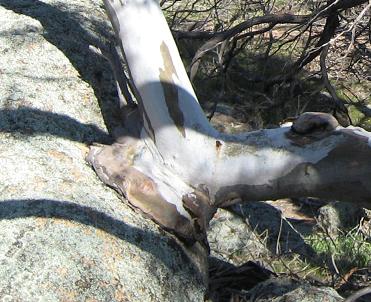
There is a large Red Gum that has developed what in we’ll call large calluses, caused by branches growing out and rubbing against and in time ‘welding’ to the rocks creating additional anchor points. The callous in the photo is approximately 600 mm across.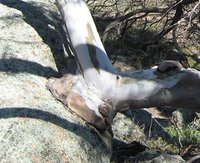
Many of the native species are currently in flower. Mikla Lewis has kindly informed us that the species with blue flowers in the picture below is Rock Isotome (Isotoma petraea) which was used by Aborigines as a substitute or addition to 'Pituri' - "a highly valued stimulant used for ceremonies, operations, socially and for spiking waterholes to aid the capture of game".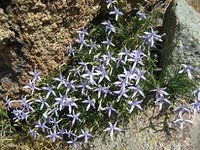
The Yellow Box (Eucalyptus melliodora) trees have an amazing volume of flowers on them, especially given the current dry conditions.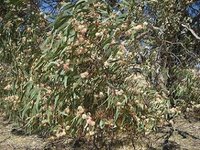
Rock Formations
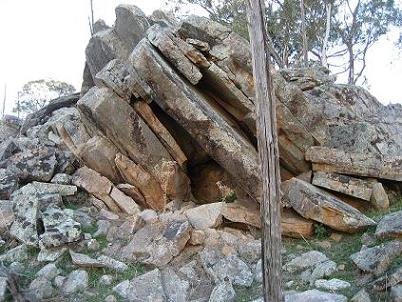
Along one of the ridges are 3 outcrops of rocks that are akin to packs of playing cards on their sides. The one in this photo has a shelter under it, used by species such as Red-Necked Wallabies and Euros.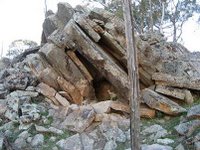
Reptiles
Geckos are regularly seen under bark in fallen timber. This one hangs around the house and is deadly on moths!
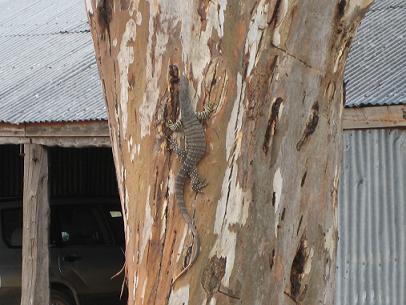
We’ve knick-named the large Lace Monitor (Varanus varius), also known as a Goanna, that lives in the trees in the front paddock “The Boss”. It is about 1.5 metres long and occasionally wanders around the house and sheds like it owns the place!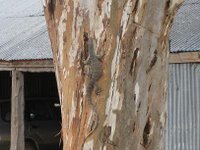
Native Animals
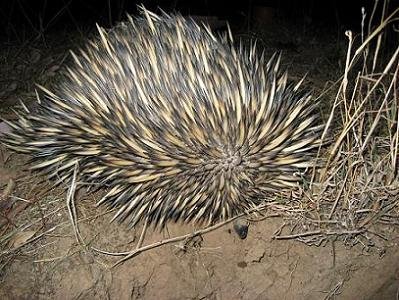
It’s not that often we get to see Echidnas on Ochre Arch, but they are around. We snapped this one down the creek in the front paddock after dark last week.
Birds
The Crested Pigeons that nest in the car shed have successfully raised a new generation: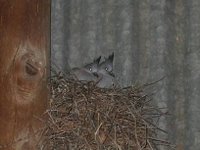
Three more bird species have been identified, taking the total to 61 so far:
• Black-faced Cuckoo-shrike (Coracina novaehollandiae)
• Leaden Flycatcher (Myiagra rubecula)
• Brown Thornbill (Acanthiza pusilla)
Insects
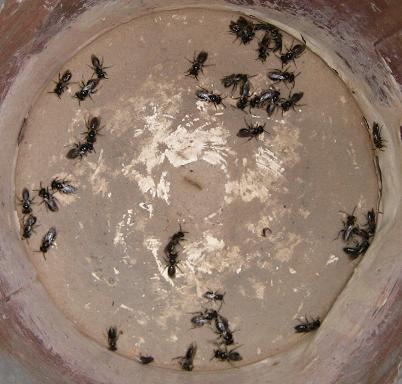
Following light rain in early September some native bees invaded the rain gauge on the property.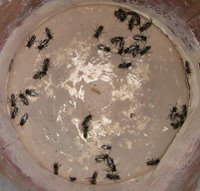
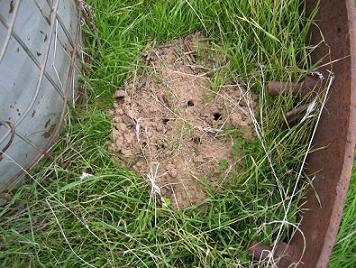
Dung beetles were also ‘weaving their magic’, digging manure deep into the soil and creating their tunnels that improve aeration and water infiltration.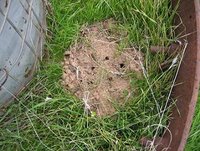
In Closing
There’s much more we could tell you but in the interest of space and time that will do for know. Phillip continues to compile other more in depth articles on his blog site, http://ochrearchives.blogspot.com.
Once again, feedback is most welcome, via email to pdiprose@optusnet.com.au. Best wishes for the festive season.
Kind regards… Phillip & Jan Diprose
Link to: Ochre Archives Newsletter - Issue No. 1
Link to: Ochre Archives Newsletter - Issue No. 2
Welcome to the third edition of ‘Ochre Archives’. Our farm continues to reveal its features and secrets to us, as you will see in what follows.
Findings from recent trips to the farm
Trees and Shrubs
There is a large Red Gum that has developed what in we’ll call large calluses, caused by branches growing out and rubbing against and in time ‘welding’ to the rocks creating additional anchor points. The callous in the photo is approximately 600 mm across.
Many of the native species are currently in flower. Mikla Lewis has kindly informed us that the species with blue flowers in the picture below is Rock Isotome (Isotoma petraea) which was used by Aborigines as a substitute or addition to 'Pituri' - "a highly valued stimulant used for ceremonies, operations, socially and for spiking waterholes to aid the capture of game".

The Yellow Box (Eucalyptus melliodora) trees have an amazing volume of flowers on them, especially given the current dry conditions.

Rock Formations
Along one of the ridges are 3 outcrops of rocks that are akin to packs of playing cards on their sides. The one in this photo has a shelter under it, used by species such as Red-Necked Wallabies and Euros.
Reptiles
Geckos are regularly seen under bark in fallen timber. This one hangs around the house and is deadly on moths!

We’ve knick-named the large Lace Monitor (Varanus varius), also known as a Goanna, that lives in the trees in the front paddock “The Boss”. It is about 1.5 metres long and occasionally wanders around the house and sheds like it owns the place!
Native Animals
It’s not that often we get to see Echidnas on Ochre Arch, but they are around. We snapped this one down the creek in the front paddock after dark last week.
Birds
The Crested Pigeons that nest in the car shed have successfully raised a new generation:

Three more bird species have been identified, taking the total to 61 so far:
• Black-faced Cuckoo-shrike (Coracina novaehollandiae)
• Leaden Flycatcher (Myiagra rubecula)
• Brown Thornbill (Acanthiza pusilla)
Insects
Following light rain in early September some native bees invaded the rain gauge on the property.
Dung beetles were also ‘weaving their magic’, digging manure deep into the soil and creating their tunnels that improve aeration and water infiltration.
In Closing
There’s much more we could tell you but in the interest of space and time that will do for know. Phillip continues to compile other more in depth articles on his blog site, http://ochrearchives.blogspot.com.
Once again, feedback is most welcome, via email to pdiprose@optusnet.com.au. Best wishes for the festive season.
Kind regards… Phillip & Jan Diprose
Link to: Ochre Archives Newsletter - Issue No. 1
Link to: Ochre Archives Newsletter - Issue No. 2
Thursday, 12 October 2006
Global & Australian Water Situation
Last night I attended a Lecture at Melbourne University given by Maude Barlow on the topic “The Right to Water: Approaches to the World Water Crisis”. Maude is the National Chairperson of the Council of Canadians (Canada's largest citizen's advocacy organisation), a Director with the International Forum on Globalization and co-author (with Tony Clarke) of "Blue Gold. The fight to stop the corporate theft of the world's water".
Her initial foray into this critical global issue started over 15 years ago in response to Canadian concerns about the USA taking actions to source water from Canada to help sustain its business and population needs concerns that remain valid today.
What follows is a sample of the facts and issues she spoke of last night.
* Canada is known as a water rich country, whilst the Mid and South West of the USA is going through the driest recorded period in the past 500 years.
* The World Trade Organisation now classifies water as a ‘good’ making it ‘acceptable’ for it to be traded and treated the same as another other commodity.
Maude outlined 2 major concerns in respect of water globally:
1. Ecological
Surface and ground water is progressively becoming polluted. In China, as an example, some 85 % of surface and 90 % of ground water in the cities is polluted due mainly to the impact of manufacturing. The Chinese believe that 60 times the profit is made from a single drop of water if used in manufacturing as opposed to agriculture, and as a consequence have diverted water from the agricultural north to the cities.
Coca Cola now supplies 10 % of human ‘liquid intake’ in industrialized countries and has a goal to increase this to 20 %. They have constructed huge armed fortresses in poor countries within which they have undergound water pumping facilities. In some of the cold climates they now ‘harvest’ melting ice in the spring. One of the core strategies for achieving the ‘liquid intake’ objective is through negotiating agreements with schools whereby the higher the per capita consumption of Coca Cola the higher the profit margin will be to the schools from these sales.
Mexico city is currently sinking due to the extraction of underground water, and they are piping water in.
2. Water Inequity
Globally it is estimated that 2 billion people do not currently have adequate water supplies, whilst it is wasted by the rich. In one poor country the poor pay about 14 times the amount for water compared to the rich – driven by the rich having the water piped to their houses whilst the poor have to pay for water transport.
Last year 200 billion litres of water was bottled and sold creating a substantial pollution issue with disposal of the plastic bottles. It is Maude’s view that water should not belong to any person or corporation, and that it is a basic human right to have good quality adequate water supplies.
Australia
Australia is the driest human inhabited continent with the most variable rainfall - which is declining. Our rivers are salinated and our aquifers under the cities are being polluted and drained. The rate of water extraction in 25 % of the water catchment areas throughout the continent exceeds to rate of recharge, and our population is forecast to grow by 25 % in the next 15 years. At current water usage rates Sydney is competing with Beijing and Mexico City to be the first major city in the world to run out of water. Our general populace (and particularly our politicians) believes that we should continue to strive for unlimited economic growth. We are the 3rd highest per capita users in the world, after the USA and Canada. Since the 1990’s our water usage has increased by 65 %, and there has been a 90 % increase in ground water use. We are also a massive exporter of “Virtual Water” – water is used to produce goods that are then exported – and by so doing we are exporting ‘fruits’ (for want of a better term) using water in such as away that we damage the environment.
Currently the Federal Government is espousing 3 ‘solutions’:
1. Installation of desalination plants. These should be seen as a last resort as they are incredibly power hungry (electricity – generated via non-renewable resources) and they generate substantial pollution in the air (visual and smell) and water around them
2. Increase underground water pumping
3. Introduce water trading – This is likely to increase the gaps between the haves and the have nots. The biggest problem will come if we allow the government to introduce ‘corporate middlemen’ (apologies – this is not meant to be a sexist term) who make profits out of buying (e.g. from farmers) and selling (e.g. to city users) water. There have been instances overseas where these decisions have been made, with disastrous social consequences.
Recommendations
Maude suggests that our community and governments need to take 3 significant steps:
A) Accept that we can no longer sustain ‘unlimited growth
B) Create a new ‘water ethic’ encouraging better practices. Maude quoted Martin Luther King who once said: “Legislation won’t restrain the heart, but will help restrain the heartless”.
C) Water needs to be acknowledged as a basic human right rather than a good or commodity
Getting involved
Those seeking more information or wanting to get involved should check out the Watermark Australia website at http://www.watermarkaustralia.org.au/ (email enquiries@watermarkaustralia.org.au) which is funded by the Victorian Women’s Trust (http://www.vwt.org.au/.).
Her initial foray into this critical global issue started over 15 years ago in response to Canadian concerns about the USA taking actions to source water from Canada to help sustain its business and population needs concerns that remain valid today.
What follows is a sample of the facts and issues she spoke of last night.
* Canada is known as a water rich country, whilst the Mid and South West of the USA is going through the driest recorded period in the past 500 years.
* The World Trade Organisation now classifies water as a ‘good’ making it ‘acceptable’ for it to be traded and treated the same as another other commodity.
Maude outlined 2 major concerns in respect of water globally:
1. Ecological
Surface and ground water is progressively becoming polluted. In China, as an example, some 85 % of surface and 90 % of ground water in the cities is polluted due mainly to the impact of manufacturing. The Chinese believe that 60 times the profit is made from a single drop of water if used in manufacturing as opposed to agriculture, and as a consequence have diverted water from the agricultural north to the cities.
Coca Cola now supplies 10 % of human ‘liquid intake’ in industrialized countries and has a goal to increase this to 20 %. They have constructed huge armed fortresses in poor countries within which they have undergound water pumping facilities. In some of the cold climates they now ‘harvest’ melting ice in the spring. One of the core strategies for achieving the ‘liquid intake’ objective is through negotiating agreements with schools whereby the higher the per capita consumption of Coca Cola the higher the profit margin will be to the schools from these sales.
Mexico city is currently sinking due to the extraction of underground water, and they are piping water in.
2. Water Inequity
Globally it is estimated that 2 billion people do not currently have adequate water supplies, whilst it is wasted by the rich. In one poor country the poor pay about 14 times the amount for water compared to the rich – driven by the rich having the water piped to their houses whilst the poor have to pay for water transport.
Last year 200 billion litres of water was bottled and sold creating a substantial pollution issue with disposal of the plastic bottles. It is Maude’s view that water should not belong to any person or corporation, and that it is a basic human right to have good quality adequate water supplies.
Australia
Australia is the driest human inhabited continent with the most variable rainfall - which is declining. Our rivers are salinated and our aquifers under the cities are being polluted and drained. The rate of water extraction in 25 % of the water catchment areas throughout the continent exceeds to rate of recharge, and our population is forecast to grow by 25 % in the next 15 years. At current water usage rates Sydney is competing with Beijing and Mexico City to be the first major city in the world to run out of water. Our general populace (and particularly our politicians) believes that we should continue to strive for unlimited economic growth. We are the 3rd highest per capita users in the world, after the USA and Canada. Since the 1990’s our water usage has increased by 65 %, and there has been a 90 % increase in ground water use. We are also a massive exporter of “Virtual Water” – water is used to produce goods that are then exported – and by so doing we are exporting ‘fruits’ (for want of a better term) using water in such as away that we damage the environment.
Currently the Federal Government is espousing 3 ‘solutions’:
1. Installation of desalination plants. These should be seen as a last resort as they are incredibly power hungry (electricity – generated via non-renewable resources) and they generate substantial pollution in the air (visual and smell) and water around them
2. Increase underground water pumping
3. Introduce water trading – This is likely to increase the gaps between the haves and the have nots. The biggest problem will come if we allow the government to introduce ‘corporate middlemen’ (apologies – this is not meant to be a sexist term) who make profits out of buying (e.g. from farmers) and selling (e.g. to city users) water. There have been instances overseas where these decisions have been made, with disastrous social consequences.
Recommendations
Maude suggests that our community and governments need to take 3 significant steps:
A) Accept that we can no longer sustain ‘unlimited growth
B) Create a new ‘water ethic’ encouraging better practices. Maude quoted Martin Luther King who once said: “Legislation won’t restrain the heart, but will help restrain the heartless”.
C) Water needs to be acknowledged as a basic human right rather than a good or commodity
Getting involved
Those seeking more information or wanting to get involved should check out the Watermark Australia website at http://www.watermarkaustralia.org.au/ (email enquiries@watermarkaustralia.org.au) which is funded by the Victorian Women’s Trust (http://www.vwt.org.au/.).
Wednesday, 4 October 2006
Domestic Animal Breeding Tables
At the bottom of my father’s papers that Mum and I sorted through after he passed away some years ago was a document titled “Breeding Tables”. It lists the main types of domestic farm animals together with information on the duration of various breeding aspects. I came across the document again earlier today and decided to create a blog article outlining the core content. Here goes!
GESTATION PERIOD (days): Mares 340, Cows 283, Ewes 150, Sows 112, and Bitches 63
OESTRUM (HEAT) PERIODS:
Duration: Mare 5-7 days, Cow 1 day, Sow 1-2 days, Ewe 2-4 days, Bitch 1-3 weeks
Return after Parturition: Mare 7-10 days, Cow 21-28 days, Sow 4-6 months, Ewe 5-6 weeks, Bitch 5-6 months
Return if not Impregnated: Mare 2-3 weeks or more, Cow 3-4 weeks or more, Sow 17-20 days, Ewe 20-21 days, Bitch 5-6 months
PULSE, TEMPERATURE AND RESPIRATIONS
Pulse beats per minute: Horse 38-43, Cow 50-60, Sheep75-80, Pig 70-80, Dog 80-90
Respirations per minute: Horse 8-12, Cow 12-16, Sheep 20-30, Pig 20-30, Dog 15-25
Temperature Degrees Celsius: Horse 37.8-38.3, Cow 38.3-38.9, Sheep 39.4-40.0, Pig 38.9-39.4, Dog 38.3-38.9
GESTATION PERIOD (days): Mares 340, Cows 283, Ewes 150, Sows 112, and Bitches 63
OESTRUM (HEAT) PERIODS:
Duration: Mare 5-7 days, Cow 1 day, Sow 1-2 days, Ewe 2-4 days, Bitch 1-3 weeks
Return after Parturition: Mare 7-10 days, Cow 21-28 days, Sow 4-6 months, Ewe 5-6 weeks, Bitch 5-6 months
Return if not Impregnated: Mare 2-3 weeks or more, Cow 3-4 weeks or more, Sow 17-20 days, Ewe 20-21 days, Bitch 5-6 months
PULSE, TEMPERATURE AND RESPIRATIONS
Pulse beats per minute: Horse 38-43, Cow 50-60, Sheep75-80, Pig 70-80, Dog 80-90
Respirations per minute: Horse 8-12, Cow 12-16, Sheep 20-30, Pig 20-30, Dog 15-25
Temperature Degrees Celsius: Horse 37.8-38.3, Cow 38.3-38.9, Sheep 39.4-40.0, Pig 38.9-39.4, Dog 38.3-38.9
Tuesday, 3 October 2006
Snakes Keeping Other Snakes Away - A Myth
Various people have commented to me from time to time that some species of snake keep other species away. For example, some say that pythons (or carpet snakes) keep black snakes away, and that black snakes keep brown snakes away.
I decided to find out whether such statements were fact or myth, and touched base with an authority (James) who works in the Biodiversity Conservation Section of the NSW Department of Environment and Conservation. James' reply to my email reads:
"The theory that some snakes keep others away is an urban (or rural in your case) myth. Snakes have habitat preferences like every other animal so it may be that this story arose out of the fact that in certain habitats you see more of one kind of snake than another. There is no evidence that the type of competetive exclusion you are referring to occurs, in fact there are plently of areas where you will find pythons, black snakes and brown snakes living together. They tend to eat different things and use the habitat differently so as not to compete too much."
Thanks for clearing that one up, James.
I decided to find out whether such statements were fact or myth, and touched base with an authority (James) who works in the Biodiversity Conservation Section of the NSW Department of Environment and Conservation. James' reply to my email reads:
"The theory that some snakes keep others away is an urban (or rural in your case) myth. Snakes have habitat preferences like every other animal so it may be that this story arose out of the fact that in certain habitats you see more of one kind of snake than another. There is no evidence that the type of competetive exclusion you are referring to occurs, in fact there are plently of areas where you will find pythons, black snakes and brown snakes living together. They tend to eat different things and use the habitat differently so as not to compete too much."
Thanks for clearing that one up, James.
Growing Trees & Creating Hollow Log Habitats
Matt Kilby is a bloke who is passionate about trees, and is a well known and respected guru in designing tree and shrub based nature corridors and such like. If you are looking for advice and assistance in this field, Matt works for Trees for Earth whose web site is www.treesforearth.com.au.
If you are thinking of installing 'hollow log habitats' for use by birds and animals then check out www.hollowloghomes.com.au.
If you are thinking of installing 'hollow log habitats' for use by birds and animals then check out www.hollowloghomes.com.au.
Sunday, 1 October 2006
Growing lawn without watering
Last night at a dinner party here in Melbourne the question was asked by one of our hosts whether anyone had any tips on how to grow green lawns without watering. Jan and I have never watered the lawn on any of our house blocks and in recent years I’ve made several changes from conventional lawn growing practices that have at least in part resulted in us having what I consider to be reasonable year-round green grass cover on our house block. Each of these changes, together with the underlying logic is below. It is the combination of factors rather than one item in particular that provide us with the end result we now have.
Not watering the lawn
Our basic belief is that nature will make available the most appropriate vegetation type to match the soil, climatic & other conditions. Watering lawns favours the development of shallow rooted plants and creates a dependency on regular watering. Conversely not watering fosters the growth of deep rooted plants. The deeper the plant roots the greater the organic matter in the soil and the greater the ability the plants have to draw both water and minerals from depth.
It is also important to know that if treated well the type of plants growing will progressively improve to those that are generally accepted as being the best for the environment. In the early stages bare ground will be covered by mosses and in some cases lichens. In the first photo you will see ‘grass’ species growing. When we first came to our current home most of the area in the photo was bare ground and moss.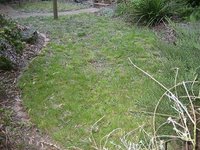
Cut the lawn at maximum mower height.
Cutting the lawn at maximum height means that there is (or should) always a reasonable amount of green leaf left on the plants. This is turn means that each plant has at least some amount of ‘solar panels’ left to continue photosynthesis, recover reasonably quickly and maintain a green appearance. Interestingly, when cattle graze a healthy pasture for short durations at high densities they tend to leave the pasture height at a level similar to what a lawnmower does at full height. Mowing at maximum height also means that it is easier to push the mower through the grass and it can be done effectively using lower revolutions and fuel.
Cut the lawn when the plants are within growth Phase 2, which also by default means the frequency of cutting is reduced.
Plants have 3 core growth phases:
Phase 1 – Essentially plants are ‘getting organised’ in terms of root mass and leaf volume for the major (next) growth phase. Most people tend to cut their lawns while the plants are still in Phase 1. This equates to over-grazing in a farming system. Plant root mass declines such that the plants die (in some cases) or at least never really prosper. Without ground cover and organic soil matter the loss of soil moisture is very rapid.
Phase 2 – This is the ‘power growth’ phase and lasts from the end of Phase 1 through to the time that the plant has just flowered and set seed but is still green. To grow healthy and dense pasture in a grazing enterprise the goal is to introduce stock when the plants are near the top or end of Phase 2. Mowing the lawn at this stage has the same impact of encouraging denser plant tillering and keeping the plants still in the green phase. NB. There is still likely to be ‘haying off’ or drying during the peak of summer but if the grass stand contains perennial plants there will still be a small amount of green leaf matter in the dry stand – meaning that recovery after rains is very rapid.
Phase 3 – This is pretty much the ‘haying off’ or drying period for the plant, during which gradual senescence occurs.
Cutting the lawn within a couple of days of rain
Until such time as the lawn creates its own level of ground cover I only mow within a couple of days after it rains. In so doing I’m avoiding creating a mini-dust storm and also ensuring that as much top soil and organic matter remains on the soil surface as possible.
Not using the grass catcher i.e. leave the clippings on the lawn
The lawn clippings (where they are thrown by the mower) will normally not be noticeable within 2 days of mowing. So doing allows nature to recycle the nutrients, reducing or eliminating the need to apply external fertilizers, and supplies a natural mulch – increasing soil moisture retention and infiltration. It also makes the effort of mowing much less and avoids the need to (and expense of) placing the clipping somewhere else.
Not applying fertilizers
The application of inorganic fertilizers (which are by default ‘salts’ as they are water soluble) can increase the salt levels in the soil and in so doing kill off worms and other in-soil organisms. I guess I could apply organic fertilizers. However this would make the grass grow faster, meaning I’d have to mow more often, which I don’t want to do!
Worms play a very important role in soil health through creating ‘tunnels’ to enhance water infiltration and also improving soil quality. Did you know that all worms have the ability to detoxify carcinogenic substances in the soil (assuming they are able to actually survive in the toxic soil)?
Not trimming the edges (or out the back at least)
The main reason I don’t do this is that I could not be bothered! However by not trimming the edge I am also encouraging ‘edge effect’ within the back-yard environment – creating a different environment or micro-climate for the protection and encouragement of creatures such as small lizards, which in turn help control the numbers of some ‘pest’ organisms such as flies and other insects.
Not using Glyphosate to kill plants in the lawn
Glyphosate is the key ingredient in Roundup, and is used by many people to kill unwanted grass around edges, in garden beds, and in cropping. It is known and accepted that glyphosate kills tadpoles (and by default up to 95 % of frogs in the environment) if it ends up in creeks and water supplies. Allowing the chemical to go into water is in direct contravention of the labeling instructions, but never-the-less I happen to believe frogs (especially tadpoles) have an important role in nature and do not want to take the chance of making an error.
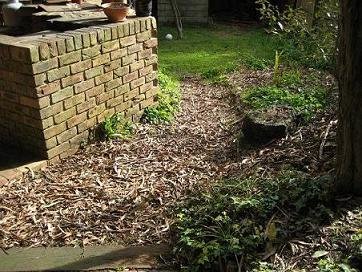
Covering bare walking tracks with fallen leaves and bark from eucalypt trees
Most people tend to lay pavers, which pretty much prevent water infiltration and encourages more rapid run-off, leading to flash flooding. Using bark and leaves reduces cost, improves infiltration, stops erosion, provides a place to spread the leaves and bark (rather than take the stuff to the tip), and provides a safer surface to be on in the wet as it is non-slip. Of course we also spread the leaves and bark on garden beds and other bare ground to provide cover and natural mulch.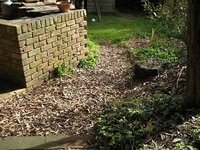
Minimising the use of pavers in other locations
Our backyard, like many others, has a basketball ring and clothes line. It was tempting initially to pave the area under the clothes line and where the family plays basketball but we resisted; and only have pavers where one stands when actually hanging out the washing and practicing penalty basketball shots. Thus we are still allowing as much of the backyard as possible to directly receive and utilise natural rainwater. In the 3rd photograph you will see how healthy our lawn is, together with the location of some of the pavers ... and where the family plays basketball! Interestingly, if we don't play basketball for a couple of months the grass grows back over the bare ground progressively.
Looking for & marveling at the gradual increase in plant diversity
Rather than ‘freak out’ when seeing, say, a milk or other thistle in the backyard we look at the plants and wonder what it is in the environment that led to nature’s decision to prompt such a plant to grow. Thistles are a broadleaf and have tap roots. Thus they are very effective at covering bare ground (reducing erosion and evaporation) and opening up the soil structure. They are also fairly low-down in the plant succession hierarchy. Thus as the health of the soil and ground cover increases their numbers decrease and will disappear. Broadleaf plants have great difficulty growing in dense healthy and high perennial pastures as they don't get the light they need to start, and find it difficult to spread their leaves.
Trialing ideas
Most people have grown up in a paradigm telling them that a good lawn is a single plant species (monoculture) of, say, Couch or Kikuyu or Buffalo that is kept even through regular cutting. I challenge readers who have such a mindset to have the courage to run a small experiment in their backyard by setting aside an area of, say, 4 square metres (2 metres X 2 metres), not mowing it for 3-6 months, and closely watching to see what grows. Don’t freak out and run for the chemicals if you see Clover occurring … this is nature creating its own source of nitrogen for the benefit of other plants. If after then you mow that area when the plants are in Phase 2 you should be able to create an acceptable looking lawn that you can use like you have in the past.
Not watering the lawn
Our basic belief is that nature will make available the most appropriate vegetation type to match the soil, climatic & other conditions. Watering lawns favours the development of shallow rooted plants and creates a dependency on regular watering. Conversely not watering fosters the growth of deep rooted plants. The deeper the plant roots the greater the organic matter in the soil and the greater the ability the plants have to draw both water and minerals from depth.
It is also important to know that if treated well the type of plants growing will progressively improve to those that are generally accepted as being the best for the environment. In the early stages bare ground will be covered by mosses and in some cases lichens. In the first photo you will see ‘grass’ species growing. When we first came to our current home most of the area in the photo was bare ground and moss.

Cut the lawn at maximum mower height.
Cutting the lawn at maximum height means that there is (or should) always a reasonable amount of green leaf left on the plants. This is turn means that each plant has at least some amount of ‘solar panels’ left to continue photosynthesis, recover reasonably quickly and maintain a green appearance. Interestingly, when cattle graze a healthy pasture for short durations at high densities they tend to leave the pasture height at a level similar to what a lawnmower does at full height. Mowing at maximum height also means that it is easier to push the mower through the grass and it can be done effectively using lower revolutions and fuel.
Cut the lawn when the plants are within growth Phase 2, which also by default means the frequency of cutting is reduced.
Plants have 3 core growth phases:
Phase 1 – Essentially plants are ‘getting organised’ in terms of root mass and leaf volume for the major (next) growth phase. Most people tend to cut their lawns while the plants are still in Phase 1. This equates to over-grazing in a farming system. Plant root mass declines such that the plants die (in some cases) or at least never really prosper. Without ground cover and organic soil matter the loss of soil moisture is very rapid.
Phase 2 – This is the ‘power growth’ phase and lasts from the end of Phase 1 through to the time that the plant has just flowered and set seed but is still green. To grow healthy and dense pasture in a grazing enterprise the goal is to introduce stock when the plants are near the top or end of Phase 2. Mowing the lawn at this stage has the same impact of encouraging denser plant tillering and keeping the plants still in the green phase. NB. There is still likely to be ‘haying off’ or drying during the peak of summer but if the grass stand contains perennial plants there will still be a small amount of green leaf matter in the dry stand – meaning that recovery after rains is very rapid.
Phase 3 – This is pretty much the ‘haying off’ or drying period for the plant, during which gradual senescence occurs.
Cutting the lawn within a couple of days of rain
Until such time as the lawn creates its own level of ground cover I only mow within a couple of days after it rains. In so doing I’m avoiding creating a mini-dust storm and also ensuring that as much top soil and organic matter remains on the soil surface as possible.
Not using the grass catcher i.e. leave the clippings on the lawn
The lawn clippings (where they are thrown by the mower) will normally not be noticeable within 2 days of mowing. So doing allows nature to recycle the nutrients, reducing or eliminating the need to apply external fertilizers, and supplies a natural mulch – increasing soil moisture retention and infiltration. It also makes the effort of mowing much less and avoids the need to (and expense of) placing the clipping somewhere else.
Not applying fertilizers
The application of inorganic fertilizers (which are by default ‘salts’ as they are water soluble) can increase the salt levels in the soil and in so doing kill off worms and other in-soil organisms. I guess I could apply organic fertilizers. However this would make the grass grow faster, meaning I’d have to mow more often, which I don’t want to do!
Worms play a very important role in soil health through creating ‘tunnels’ to enhance water infiltration and also improving soil quality. Did you know that all worms have the ability to detoxify carcinogenic substances in the soil (assuming they are able to actually survive in the toxic soil)?
Not trimming the edges (or out the back at least)
The main reason I don’t do this is that I could not be bothered! However by not trimming the edge I am also encouraging ‘edge effect’ within the back-yard environment – creating a different environment or micro-climate for the protection and encouragement of creatures such as small lizards, which in turn help control the numbers of some ‘pest’ organisms such as flies and other insects.
Not using Glyphosate to kill plants in the lawn
Glyphosate is the key ingredient in Roundup, and is used by many people to kill unwanted grass around edges, in garden beds, and in cropping. It is known and accepted that glyphosate kills tadpoles (and by default up to 95 % of frogs in the environment) if it ends up in creeks and water supplies. Allowing the chemical to go into water is in direct contravention of the labeling instructions, but never-the-less I happen to believe frogs (especially tadpoles) have an important role in nature and do not want to take the chance of making an error.
Covering bare walking tracks with fallen leaves and bark from eucalypt trees
Most people tend to lay pavers, which pretty much prevent water infiltration and encourages more rapid run-off, leading to flash flooding. Using bark and leaves reduces cost, improves infiltration, stops erosion, provides a place to spread the leaves and bark (rather than take the stuff to the tip), and provides a safer surface to be on in the wet as it is non-slip. Of course we also spread the leaves and bark on garden beds and other bare ground to provide cover and natural mulch.
Minimising the use of pavers in other locations
Our backyard, like many others, has a basketball ring and clothes line. It was tempting initially to pave the area under the clothes line and where the family plays basketball but we resisted; and only have pavers where one stands when actually hanging out the washing and practicing penalty basketball shots. Thus we are still allowing as much of the backyard as possible to directly receive and utilise natural rainwater. In the 3rd photograph you will see how healthy our lawn is, together with the location of some of the pavers ... and where the family plays basketball! Interestingly, if we don't play basketball for a couple of months the grass grows back over the bare ground progressively.

Looking for & marveling at the gradual increase in plant diversity
Rather than ‘freak out’ when seeing, say, a milk or other thistle in the backyard we look at the plants and wonder what it is in the environment that led to nature’s decision to prompt such a plant to grow. Thistles are a broadleaf and have tap roots. Thus they are very effective at covering bare ground (reducing erosion and evaporation) and opening up the soil structure. They are also fairly low-down in the plant succession hierarchy. Thus as the health of the soil and ground cover increases their numbers decrease and will disappear. Broadleaf plants have great difficulty growing in dense healthy and high perennial pastures as they don't get the light they need to start, and find it difficult to spread their leaves.
Trialing ideas
Most people have grown up in a paradigm telling them that a good lawn is a single plant species (monoculture) of, say, Couch or Kikuyu or Buffalo that is kept even through regular cutting. I challenge readers who have such a mindset to have the courage to run a small experiment in their backyard by setting aside an area of, say, 4 square metres (2 metres X 2 metres), not mowing it for 3-6 months, and closely watching to see what grows. Don’t freak out and run for the chemicals if you see Clover occurring … this is nature creating its own source of nitrogen for the benefit of other plants. If after then you mow that area when the plants are in Phase 2 you should be able to create an acceptable looking lawn that you can use like you have in the past.
Friday, 29 September 2006
Fire Risk posed by Electric Fencing
It was recently suggested to me that the use of electronic fencing in areas such as Grenfell creates an unacceptable fire risk, especially during the summer months. With this as a backdrop I set about conducting some research on the subject. Below are the organisations and people I contacted or gathered information and views from, together with what I found out.
Wesfarmers Federation Insurance (WFI)
I contacted one of the WFI Regional Managers who in turn spoke with a couple of his peers. In short WFI does not consider electric fencing to constitute a material fire risk and thus does not charge a premium over conventional fencing where these types of fences are used.
Gallagher Australia Pty Limited (GAP)
Gallagher is one of the leading global designers and manufacturers of “Power Fence Systems”. I contacted GAP and received an email response which in part reads:
“Re starting fires - the voltage is sent through at a very low ampere which makes it very difficult for a fire to start. On extremely hot days you can turn your fence off for greater piece of mind as the animals won't be moving around anyway on the really hot days.”
Australian Government Department of Environment & Heritage
A web search brought to light the following on the Federal Government Department of Environment & Heritage website (see link to full article if required):
“7.3.3 Fire risk posed by electrical fences
Electric fences have been suspected of causing several fires (McCutchan 1980, Sexton 1984), however McCutchan (1980) concluded that the combination of conditions necessary to ignite surrounding vegetation make electric fences a possible but improbable cause of bushfires. He found that an arc can pass through the air between an electric wire and another electrical conductor if these components are separated by several millimetres or less. Alternatively, an electrical 'flashover' can occur across a suitable green leaf that contacts an electric wire and a conductor separated by 20 mm or less. These events will only be capable of starting a fire if very dry, finely divided tinder, such as thistle down, is present between the conductors, and there is also sufficient dry vegetation within the immediate vicinity to be ignited. High temperatures, low humidity and the presence of wind are conditions that will cause the tinder to become suitably dry (McCutchan 1980).
To reduce any potential fire risk in areas where bushfires are a hazard it has been recommended that fences be well maintained, porcelain insulators be used (Sexton 1984), vegetation be cleared in the immediate vicinity of the fence line (Australia Standards and Standards New Zealand 2003) and, in high fire risk seasons, the output voltage be reduced or current-limiting resistors installed (Australia Standards and Standards New Zealand 2003, Sexton 1984). However, Coman and McCutchan (1994) point out that reducing the voltage is unlikely to greatly reduce the fire risk and, because higher voltages are likely to be necessary in the drier months to counteract the poor conductivity of animal fur, this may reduce the effectiveness of the fence."
NSW Rural Fire Service - Forbes
I spoke to the Forbes office of the NSW Fire Service. In the 20 years the person I spoke to has been employed by the NSW Rural Fire Service he is aware of 1 or 2 instances where fires started on farms that had electric fencing, but it was not clear what the cause of the fire was i.e. electric fencing was suspected but not proven. Electric fencing is not considered to be a material fire risk. The major ‘man-made’ causes of fires on farms include angle grinders, welders, headers, slashers and power poles (cross-arm breaks).
NSW Rural Fire Service – Volunteer – Orange
A family member who lives on a farm at Orange and is a volunteer member of the local bushfire brigade advised that he went to a fire a few years ago that burnt down the local gun club. The fire was allegedly started by an electric fence but is at present subject to a Coronial inquiry (as the damage caused was over $50,000) and cause cannot be confirmed.
“Farm fire causes are many and range from machinery sparks, stubble burns (& burn off in general) that have got away, hot mufflers and cigarette butts in stubble/grass, lightning strikes etc. and of course arson. The inquiry into a fire at Alectown a few years ago found that the fire started by a tree touching power lines.”
NSW Rural Fire Service - Sydney
The Customer Support office advised that the RFS does not have statistics regarding research into the fire risk associated with electric fencing. They referred me to Section 7.3.3 of the 'Cost effective feral animal exclusion fencing for areas of high conservation value in Australia' document produced by the Australian Department of the Environment and Heritage - which I'd already located (and have included above).
For information in relation to Asset Protection Zones or other Bush Fire Protection Methods for building in a bush fire prone I was referred to the link below; http://www.rfs.nsw.gov.au/dsp_content.cfm?CAT_ID=518
Wesfarmers Federation Insurance (WFI)
I contacted one of the WFI Regional Managers who in turn spoke with a couple of his peers. In short WFI does not consider electric fencing to constitute a material fire risk and thus does not charge a premium over conventional fencing where these types of fences are used.
Gallagher Australia Pty Limited (GAP)
Gallagher is one of the leading global designers and manufacturers of “Power Fence Systems”. I contacted GAP and received an email response which in part reads:
“Re starting fires - the voltage is sent through at a very low ampere which makes it very difficult for a fire to start. On extremely hot days you can turn your fence off for greater piece of mind as the animals won't be moving around anyway on the really hot days.”
Australian Government Department of Environment & Heritage
A web search brought to light the following on the Federal Government Department of Environment & Heritage website (see link to full article if required):
“7.3.3 Fire risk posed by electrical fences
Electric fences have been suspected of causing several fires (McCutchan 1980, Sexton 1984), however McCutchan (1980) concluded that the combination of conditions necessary to ignite surrounding vegetation make electric fences a possible but improbable cause of bushfires. He found that an arc can pass through the air between an electric wire and another electrical conductor if these components are separated by several millimetres or less. Alternatively, an electrical 'flashover' can occur across a suitable green leaf that contacts an electric wire and a conductor separated by 20 mm or less. These events will only be capable of starting a fire if very dry, finely divided tinder, such as thistle down, is present between the conductors, and there is also sufficient dry vegetation within the immediate vicinity to be ignited. High temperatures, low humidity and the presence of wind are conditions that will cause the tinder to become suitably dry (McCutchan 1980).
To reduce any potential fire risk in areas where bushfires are a hazard it has been recommended that fences be well maintained, porcelain insulators be used (Sexton 1984), vegetation be cleared in the immediate vicinity of the fence line (Australia Standards and Standards New Zealand 2003) and, in high fire risk seasons, the output voltage be reduced or current-limiting resistors installed (Australia Standards and Standards New Zealand 2003, Sexton 1984). However, Coman and McCutchan (1994) point out that reducing the voltage is unlikely to greatly reduce the fire risk and, because higher voltages are likely to be necessary in the drier months to counteract the poor conductivity of animal fur, this may reduce the effectiveness of the fence."
NSW Rural Fire Service - Forbes
I spoke to the Forbes office of the NSW Fire Service. In the 20 years the person I spoke to has been employed by the NSW Rural Fire Service he is aware of 1 or 2 instances where fires started on farms that had electric fencing, but it was not clear what the cause of the fire was i.e. electric fencing was suspected but not proven. Electric fencing is not considered to be a material fire risk. The major ‘man-made’ causes of fires on farms include angle grinders, welders, headers, slashers and power poles (cross-arm breaks).
NSW Rural Fire Service – Volunteer – Orange
A family member who lives on a farm at Orange and is a volunteer member of the local bushfire brigade advised that he went to a fire a few years ago that burnt down the local gun club. The fire was allegedly started by an electric fence but is at present subject to a Coronial inquiry (as the damage caused was over $50,000) and cause cannot be confirmed.
“Farm fire causes are many and range from machinery sparks, stubble burns (& burn off in general) that have got away, hot mufflers and cigarette butts in stubble/grass, lightning strikes etc. and of course arson. The inquiry into a fire at Alectown a few years ago found that the fire started by a tree touching power lines.”
NSW Rural Fire Service - Sydney
The Customer Support office advised that the RFS does not have statistics regarding research into the fire risk associated with electric fencing. They referred me to Section 7.3.3 of the 'Cost effective feral animal exclusion fencing for areas of high conservation value in Australia' document produced by the Australian Department of the Environment and Heritage - which I'd already located (and have included above).
For information in relation to Asset Protection Zones or other Bush Fire Protection Methods for building in a bush fire prone I was referred to the link below; http://www.rfs.nsw.gov.au/dsp_content.cfm?CAT_ID=518
Tuesday, 26 September 2006
Ochre in the context of Aboriginal culture
Local Grenfell resident and historian, Ian Pitt, recently gave me a copy of a brochure titled “Ochre Dreaming – Victoria’s Aboriginal Tourism experience” produced by the Aboriginal Tourism Marketing Association. Ian sent me the document in light of his personal interest in Ochre Arch (having lived on the property from 1981 to 1987) and our recent discovery that Aborigines had mined red-orange ochre from underneath the natural arch on the property. What follows is a verbatim copy of the information about ochre in the context of Aboriginal culture, set out on the inside front cover of the brochure:
“Ochre is a natural earth pigment which has been used by Aboriginal people for thousands of years. Aboriginal people believe that ochre has spiritual power which is released through ceremonial ritual. Red ochre is considered sacred. In tradfitional Aboriginal life, ochre was a highly prized commodity used as currency in the Aboriginal trade system when clan groups traveled great distances for ceremony and Trade. Particular worth was placed on ochre from certain areas with mythological significance. Archaeological evidence shows that ochre was used in ceremonial rituals and almost every excavation older than 10,000 years uncovers quantities of ochre. Modern Aboriginals employ ochre for painted designs used in ceremonial body decoration and for paintings on bark or canvas. The ochre is ground to a fine powder and water is added to achieve the desired colour and consistency. Ochre is applied in a variety of ways according to the purpose and design. It is often applied through blowing from the mouth to achieve a splatter effect. For fine art work brushes made of hair or a chewed twig are used.”
Thanks Ian! For those wanting further Aboriginal tourism information check out http://www.seeaboriginaltourism.com/
“Ochre is a natural earth pigment which has been used by Aboriginal people for thousands of years. Aboriginal people believe that ochre has spiritual power which is released through ceremonial ritual. Red ochre is considered sacred. In tradfitional Aboriginal life, ochre was a highly prized commodity used as currency in the Aboriginal trade system when clan groups traveled great distances for ceremony and Trade. Particular worth was placed on ochre from certain areas with mythological significance. Archaeological evidence shows that ochre was used in ceremonial rituals and almost every excavation older than 10,000 years uncovers quantities of ochre. Modern Aboriginals employ ochre for painted designs used in ceremonial body decoration and for paintings on bark or canvas. The ochre is ground to a fine powder and water is added to achieve the desired colour and consistency. Ochre is applied in a variety of ways according to the purpose and design. It is often applied through blowing from the mouth to achieve a splatter effect. For fine art work brushes made of hair or a chewed twig are used.”
Thanks Ian! For those wanting further Aboriginal tourism information check out http://www.seeaboriginaltourism.com/
Sunday, 24 September 2006
Email newsletter issuing tips
In the past 6 months or so I've created a couple of blog sites and send out quarterly Ochre Archives newsletters from distribution lists. A friend of mine, David, who lives near Cradle Mountain in Tasmania also sends out newsletters, was having difficulties with file sizes and asked me for some tips. Both of us like to include photographs in what we send out. Below is pretty much a word-for-word copy of the ‘suggestions email’ I sent him.
“Optus restricts the size of the files it will allow a non-commercial 'user' (horrible term) to 7.0 MB, and a commercial user to 10 MB ... not much difference. Some other Internet Service Providers (ISPs) will only permit 5 MB files to enter their customers email mailboxes.
The following are the ways I know of that will allow you to potentially address the newsletter file size problem:
1. Reduce the size (and in the process the quality ... but not significantly) of your digital photo files.
The easiest way I know to do this is as follows:
a. Open the file in "Paint". To do this:
i) Open Explorer
ii) “Left click” on the photo file name once (in effect you are simply highlighting the file name)
iii) "Right click" on the file name and choose 'Open with' and then "Paint"
b. When the file is open in "Paint" select Image > Stretch/skew > and under "Stretch" reduce the 100 % horizontal and vertical numbers to, say, 25 % (both).
c. Then save the file with a different file name. In this respect I have adopted the practice of simply including the letter 'r' just before the '.' i.e. if the original name was photo.jpg then the name of the reduced file is photor.jpg. This allows me to retain the original file intact as well and distinguish the 2 going forward.
2. Set up a blog site, create the newsletters on it, and send a link to those you want to give access to.
My blogsites were set up via http://www.blogspot.com/. By putting my newsletters on the blogsite it means that I only email out a link to the site rather than an email with attachments (which the PC in fact sends individually). This means that it is much faster to send the email and the recipient can choose to download. Taking this path is a bit trickier to begin with but is fine once you get the hang of it.
If you do set up the blog site you are still best to only post small image/picture files to it. www.blogspot.com restricts its customers to a total of 300 MB of stored photos. I have adopted the practice of reducing my digital photos (using 'Paint') from around 3 MB to less that 50 KB ... and the quality is still pretty good I reckon.
3. Send the whole newsletter as a single document via www.yousendit.com
This web site allows you to give people access to files of up to 100 MB.
There are some downsides:
a. Because this web site is free for small time users it allows various companies to advertise on the site VERY AGGRESSIVELY. The main 'advertisers' are virus protection companies who install 'cookies' on the users PC and have flashing advertisements telling the users (falsely) that they have viruses on their PC and need to purchase the advertiser's software in order to be safe. When I first went on this site I nearly fell for the advertising myself ... the flashing ads 'just about frightened the wits out of me'!
b. If the person you send the link to (to do the download) does not do so within 7 days they will not be able to access the newsletter. http://www.yousendit.com/ manages its data storage by deleting posted files at intervals as short as 7 days … and longer for those who pay money.
Having said the above, this web site is extremely useful. I've used it in recent weeks with files of around 14 MB ... connected with my desire to have some proper 3D digital maps of my farm that I can use to create my farm water scheme/plan.
4. Only include 1 or 2 photos in you newsletters to make sure the total document is less than 7 MB.
5. Create relatively small distribution lists
At the beginning I used to have just one distribution list but found it too cumbersome and frustrating when something went wrong. I’ve now divided all of the names on my list into surname groups, which are currently: A-B, C, D, E-G, H, I-L, M, N-O, P, Q-S & T-Z. Did you know that the most common letter in the alphabet that European origin surnames start with is the letter H!?
When sending the newsletters within the different alphabet ranges I include the applicable alphabet range at the end of email heading.”
No doubt there are other ways of sending email newsletters with photos. Readers should please feel free to let me know other ideas that might help.
“Optus restricts the size of the files it will allow a non-commercial 'user' (horrible term) to 7.0 MB, and a commercial user to 10 MB ... not much difference. Some other Internet Service Providers (ISPs) will only permit 5 MB files to enter their customers email mailboxes.
The following are the ways I know of that will allow you to potentially address the newsletter file size problem:
1. Reduce the size (and in the process the quality ... but not significantly) of your digital photo files.
The easiest way I know to do this is as follows:
a. Open the file in "Paint". To do this:
i) Open Explorer
ii) “Left click” on the photo file name once (in effect you are simply highlighting the file name)
iii) "Right click" on the file name and choose 'Open with' and then "Paint"
b. When the file is open in "Paint" select Image > Stretch/skew > and under "Stretch" reduce the 100 % horizontal and vertical numbers to, say, 25 % (both).
c. Then save the file with a different file name. In this respect I have adopted the practice of simply including the letter 'r' just before the '.' i.e. if the original name was photo.jpg then the name of the reduced file is photor.jpg. This allows me to retain the original file intact as well and distinguish the 2 going forward.
2. Set up a blog site, create the newsletters on it, and send a link to those you want to give access to.
My blogsites were set up via http://www.blogspot.com/. By putting my newsletters on the blogsite it means that I only email out a link to the site rather than an email with attachments (which the PC in fact sends individually). This means that it is much faster to send the email and the recipient can choose to download. Taking this path is a bit trickier to begin with but is fine once you get the hang of it.
If you do set up the blog site you are still best to only post small image/picture files to it. www.blogspot.com restricts its customers to a total of 300 MB of stored photos. I have adopted the practice of reducing my digital photos (using 'Paint') from around 3 MB to less that 50 KB ... and the quality is still pretty good I reckon.
3. Send the whole newsletter as a single document via www.yousendit.com
This web site allows you to give people access to files of up to 100 MB.
There are some downsides:
a. Because this web site is free for small time users it allows various companies to advertise on the site VERY AGGRESSIVELY. The main 'advertisers' are virus protection companies who install 'cookies' on the users PC and have flashing advertisements telling the users (falsely) that they have viruses on their PC and need to purchase the advertiser's software in order to be safe. When I first went on this site I nearly fell for the advertising myself ... the flashing ads 'just about frightened the wits out of me'!
b. If the person you send the link to (to do the download) does not do so within 7 days they will not be able to access the newsletter. http://www.yousendit.com/ manages its data storage by deleting posted files at intervals as short as 7 days … and longer for those who pay money.
Having said the above, this web site is extremely useful. I've used it in recent weeks with files of around 14 MB ... connected with my desire to have some proper 3D digital maps of my farm that I can use to create my farm water scheme/plan.
4. Only include 1 or 2 photos in you newsletters to make sure the total document is less than 7 MB.
5. Create relatively small distribution lists
At the beginning I used to have just one distribution list but found it too cumbersome and frustrating when something went wrong. I’ve now divided all of the names on my list into surname groups, which are currently: A-B, C, D, E-G, H, I-L, M, N-O, P, Q-S & T-Z. Did you know that the most common letter in the alphabet that European origin surnames start with is the letter H!?
When sending the newsletters within the different alphabet ranges I include the applicable alphabet range at the end of email heading.”
No doubt there are other ways of sending email newsletters with photos. Readers should please feel free to let me know other ideas that might help.
Saturday, 19 August 2006
Online Conversion website
I recent weeks I've been doing quite a bit of research around having a water bore drilled on Ochre Arch.
It has proven necessary to convert some of the old measures like feet and gallons into metric and vice-versa, and I've found the following Online Conversion website particularly useful for this purpose.
It has proven necessary to convert some of the old measures like feet and gallons into metric and vice-versa, and I've found the following Online Conversion website particularly useful for this purpose.
Wednesday, 16 August 2006
Reducing direct marketing approaches
If you have got to the stage of being sick and tired of being direct marketed (telephone and mail) to you can place your telephone number and / or address on the Australian Direct Marketing Association "Do Not Contact" service register. Visit the ADMA website at www.adma.com.au and following the link that appears at the top of the screen headed DO NOT CONTACT SERVICE.
Taking this action will not eliminate all contacts ... but should reduce some of the contact traffic.
Taking this action will not eliminate all contacts ... but should reduce some of the contact traffic.
Saturday, 12 August 2006
Grasses used by Aboriginal People
Sue Hudson kindly provided me with a list of various species of grasses and the use/s that Aborigines had for each one. Here they are!
1. Slender rats tail (Sporobolus creber) Seeds - flour
2. Pappas grass (Enneapogon nigrans) Seeds – flour
3. Plume grass (Dichelachne micrantha) Seeds – flour
4. Hedgehog grass (Echinopogon ovatus) Seeds – flour
5. Wallaby grass (Danthonia sp) Seeds – flour
6. Swamp foxtail (Pennisetum alopecuoides) Stem/head – broom, weaving
7. Barbwire grass (Cymbopogon refractus) Seeds – flour, root/stem insect repellent
8. Kangaroo grass (Themeda australis) Seeds – flour
9. Weeping rice grass (Microlaenia stipoides) Seeds – flour
10. Wheat grass (Elamus scaber) Seeds – flour
11. Corkscrew grass (Stipa scabra) Broom/paintbrush
12. Slender bamboo grass (S. verticillata) Broom/mats/weaving
13. Blown grass (Agrotis avenacea) Seeds – flour
14. Lovegrass (Eragrostis leptostachya) Seeds – flour
15. Poa (Poa sp) Seeds – flour
16 .Wild sorghum (Sorghum leiocladum) Seeds – flour
17. Glycine (Glycine sp) Pea-vegetable
18 .Ferns - Root -vegetable but only when young and in drought
19. Rushes (Juncus/other sp) Seeds – flour, stems/leaves –weaving/mats/nets etc
20. Dock (Rumex sp) Medicinal
21. Tarvine (Berhavia sp) Root/Yam roasted, sap used to trap small birds, animals
22. Cenna Tea (Centauium) Steeped in water – tea, Roots/leaves – poultice
23. Mint bush (Prostnthera sp) Insect repellent/perfume
24. Muckram (Melichrus sp) Fruit
25. Cyprus (Callitris) Glue/sap, bark/woomera
26. Native cherry - Sap for snake bite
27. Daisy yam (Microseris lanceolata) - Tubers/yam, Leaves/salad
28. Banksia (Banksia sp) Cones used as fire stick, flowers infused as sweet drink, flowers licked as lolly
29 .T-tree (Leptospermum) Pegs for skins, clothes, leaves for insect repellent, bark for chewing for tooth ache
30. Mistletoe - Berrys eaten as fruit, leaves for fever
31. Blady grass (Imperata cylindrica) Leaves/stems - weaving
32. Grevillea (Grevillea) Nectar and gum
33. Honeysuckle - Nectar & Gum
34. Native fushsia ARATJA (Eremophila Latrobe) Fumigation or smoking ceremony, flower sucked as sweet
35. Pigweed WAKATI (Portulacca) Seeds winnowed, ground to paste for cakes
36. Wild tobacco UKIRI (Nicotiana excelsior) Mixed with ashes – smoked
37. Quondong (Santalum acuminatum) Stone used as a linament, wood used for carving totemic images, leaves used as sandpaper (fruit etc used as food)
38. Matspurge (Euphoria drummondii) Protect children from the sun/hat
39. Turpentine (Eremophila sp) Smoke used for coughs and general aches and pains
40. Parakeelya (Calandrinia balonensis) Baked in hot ashes, leaves eaten, water source/leaves sucked
41. Emu poison bush (Dubosia sp) Poisonous leaves crushed and put in waterholes to stupefy emus and fish
42. Hopbush (Dodonea sp) Placed in pit, smoke used for relief of pain
43. Bush tomato (Solanum cleistogamun) Fruit
44. Mulga (Acacia sp) Seeds most important for flour/damper, sap as sweet, wood for spears, woomeras, boomerangs and womens digging sticks
45. Native truffle (Choiromyces sp) Cooked in ashes
Thanks Sue, for passing on the information.
For those who do not know Sue is Aboriginal and one of Australia's leading archaeologists. If you would like further information you can contact Sue on mobile: 0412 649 580 email: sue.hud@bigpond.net.au.
1. Slender rats tail (Sporobolus creber) Seeds - flour
2. Pappas grass (Enneapogon nigrans) Seeds – flour
3. Plume grass (Dichelachne micrantha) Seeds – flour
4. Hedgehog grass (Echinopogon ovatus) Seeds – flour
5. Wallaby grass (Danthonia sp) Seeds – flour
6. Swamp foxtail (Pennisetum alopecuoides) Stem/head – broom, weaving
7. Barbwire grass (Cymbopogon refractus) Seeds – flour, root/stem insect repellent
8. Kangaroo grass (Themeda australis) Seeds – flour
9. Weeping rice grass (Microlaenia stipoides) Seeds – flour
10. Wheat grass (Elamus scaber) Seeds – flour
11. Corkscrew grass (Stipa scabra) Broom/paintbrush
12. Slender bamboo grass (S. verticillata) Broom/mats/weaving
13. Blown grass (Agrotis avenacea) Seeds – flour
14. Lovegrass (Eragrostis leptostachya) Seeds – flour
15. Poa (Poa sp) Seeds – flour
16 .Wild sorghum (Sorghum leiocladum) Seeds – flour
17. Glycine (Glycine sp) Pea-vegetable
18 .Ferns - Root -vegetable but only when young and in drought
19. Rushes (Juncus/other sp) Seeds – flour, stems/leaves –weaving/mats/nets etc
20. Dock (Rumex sp) Medicinal
21. Tarvine (Berhavia sp) Root/Yam roasted, sap used to trap small birds, animals
22. Cenna Tea (Centauium) Steeped in water – tea, Roots/leaves – poultice
23. Mint bush (Prostnthera sp) Insect repellent/perfume
24. Muckram (Melichrus sp) Fruit
25. Cyprus (Callitris) Glue/sap, bark/woomera
26. Native cherry - Sap for snake bite
27. Daisy yam (Microseris lanceolata) - Tubers/yam, Leaves/salad
28. Banksia (Banksia sp) Cones used as fire stick, flowers infused as sweet drink, flowers licked as lolly
29 .T-tree (Leptospermum) Pegs for skins, clothes, leaves for insect repellent, bark for chewing for tooth ache
30. Mistletoe - Berrys eaten as fruit, leaves for fever
31. Blady grass (Imperata cylindrica) Leaves/stems - weaving
32. Grevillea (Grevillea) Nectar and gum
33. Honeysuckle - Nectar & Gum
34. Native fushsia ARATJA (Eremophila Latrobe) Fumigation or smoking ceremony, flower sucked as sweet
35. Pigweed WAKATI (Portulacca) Seeds winnowed, ground to paste for cakes
36. Wild tobacco UKIRI (Nicotiana excelsior) Mixed with ashes – smoked
37. Quondong (Santalum acuminatum) Stone used as a linament, wood used for carving totemic images, leaves used as sandpaper (fruit etc used as food)
38. Matspurge (Euphoria drummondii) Protect children from the sun/hat
39. Turpentine (Eremophila sp) Smoke used for coughs and general aches and pains
40. Parakeelya (Calandrinia balonensis) Baked in hot ashes, leaves eaten, water source/leaves sucked
41. Emu poison bush (Dubosia sp) Poisonous leaves crushed and put in waterholes to stupefy emus and fish
42. Hopbush (Dodonea sp) Placed in pit, smoke used for relief of pain
43. Bush tomato (Solanum cleistogamun) Fruit
44. Mulga (Acacia sp) Seeds most important for flour/damper, sap as sweet, wood for spears, woomeras, boomerangs and womens digging sticks
45. Native truffle (Choiromyces sp) Cooked in ashes
Thanks Sue, for passing on the information.
For those who do not know Sue is Aboriginal and one of Australia's leading archaeologists. If you would like further information you can contact Sue on mobile: 0412 649 580 email: sue.hud@bigpond.net.au.
Wednesday, 9 August 2006
Noisy Minor with obsessive behaviour
For close on 12 months now at a couple of our neighbours and our own family homes in Melbourne we have all endured what could be described as something equating to ‘Chinese water torture’ at the hands (beak) of a Noisy Minor (Manorina melanocephala) with obsessive behaviour. This individual bird has developed the habit of pecking on every window in our collective houses … in its own mind attacking another bird which is in fact its own reflection.
At first we thought the bird’s behaviour had something to do with its breeding cycle so decided not to act … hoping that in time it would ‘get over it’.
ACTION TO DATE
After 3 months or so we tried different strategies designed to reduce the reflection clarity in the windows, such as smearing Ajax on the windows and also covering them with newspaper. All of this activity has been to no avail.
ULTIMATUM
In the past week or so our family decided that ‘enough was enough’ … and I was the lucky one given the task of putting in place a permanent solution.
RESEARCH
I contacted the RSPCA (http://www.rspcavic.org/) for guidance and was informed that they do not deal with these types of issues as the bird is not in duress. They did, however, refer me to Nigel’s Animal Rescue … who is one of their preferred contacts.
I called the Nigel’s Animal Rescue (http://www.animalrescue.com.au/) mobile number 0427533083 and spoke to Nigel. His own family has had similar experience to what we are going through with a Noisy Minor. They, it seems, were more fortunate in that the offending bird was only obsessing on one particular window and after a while ceased attacking it after they covered it with newspaper. In light of our situation Nigel offered to trap, relocate and release our feathered friend. Give that the bird goes to a great number of different windows it could take quite a while for the capture to occur as the bird needs to be attracted to the place where a trap is located and become accustomed to both the feeding routine and the presence of the set trap.
Noisy Minors will eat bread. Nigel suggested he would use an ‘Ecotrap Urban’ multipurpose trap manufactured in Australia by Ecotrap. These cost approximately $400 but are both durable and humane, and can be used to trap anything from small birds through to wallabies. The Ecotrap website (http://www.ecotrap.com.au/) has some excellent footage of how their traps work.
FORWARD STRATEGY
I have decided the first step is to get our Noisy Minor accustomed to eating bread … and will see what unfolds from there!
At first we thought the bird’s behaviour had something to do with its breeding cycle so decided not to act … hoping that in time it would ‘get over it’.
ACTION TO DATE
After 3 months or so we tried different strategies designed to reduce the reflection clarity in the windows, such as smearing Ajax on the windows and also covering them with newspaper. All of this activity has been to no avail.
ULTIMATUM
In the past week or so our family decided that ‘enough was enough’ … and I was the lucky one given the task of putting in place a permanent solution.
RESEARCH
I contacted the RSPCA (http://www.rspcavic.org/) for guidance and was informed that they do not deal with these types of issues as the bird is not in duress. They did, however, refer me to Nigel’s Animal Rescue … who is one of their preferred contacts.
I called the Nigel’s Animal Rescue (http://www.animalrescue.com.au/) mobile number 0427533083 and spoke to Nigel. His own family has had similar experience to what we are going through with a Noisy Minor. They, it seems, were more fortunate in that the offending bird was only obsessing on one particular window and after a while ceased attacking it after they covered it with newspaper. In light of our situation Nigel offered to trap, relocate and release our feathered friend. Give that the bird goes to a great number of different windows it could take quite a while for the capture to occur as the bird needs to be attracted to the place where a trap is located and become accustomed to both the feeding routine and the presence of the set trap.
Noisy Minors will eat bread. Nigel suggested he would use an ‘Ecotrap Urban’ multipurpose trap manufactured in Australia by Ecotrap. These cost approximately $400 but are both durable and humane, and can be used to trap anything from small birds through to wallabies. The Ecotrap website (http://www.ecotrap.com.au/) has some excellent footage of how their traps work.
FORWARD STRATEGY
I have decided the first step is to get our Noisy Minor accustomed to eating bread … and will see what unfolds from there!
Monday, 7 August 2006
Telecommunications in the bush
We recently brought Ochre Arch into the 1970s by having the ‘phone connected. Telstra was the provider we selected given that the farm is 25 km from the nearest town (Grenfell) and they are the only telecommunications company that still has real people / staff living in and working from the smaller towns and thus have the ability to respond to faults and difficulties when and if things happen to go wrong. Telstra also happens to have a competitive range of services on offer.
I decided to write a post about our overall experience mainly to give the city folk some insight into what telecommunications really is like in the bush.
SOME CONTEXT
Our family is a reasonably heavy user of telephone, and particularly internet services. In all we now have services from 3 different providers:
Telstra: For the farm phone
Optus: Land line and cable internet to the home in Melbourne. We started using Optus whilst at Wollongong in the mid 1990’s – at a time when their rates were extremely competitive and they were in their ‘innovative customer-focused’ phase.
Three: 3 X 3G technology mobile ‘phones, recently upgraded from Orange. Our decision to go with Orange some years ago was because at that stage they had an awesome offer where calls to landlines within about a 2 km radius of the house were at local call rates AND for calls outside the Orange coverage area (basically Melbourne and Sydney metropolitan areas) Orange used the Telstra CDMA network. We switched to the 3G phones in response to an advice from Orange stating that they were going to shut down the CDMA phones at the end of August and had a “too good to refuse” offer on the table to cover the purchase of new mobiles.
HISTORY OF TELEPHONE CONNECTION ON OCHRE ARCH
A telephone service was first connected to Ochre Arch some time during the 1950’s when the Causers’ owned and lived on the place. At that time the connection was via overhead wiring and a ‘party line’ system operated.
In the 1970’s when the Hamptons’ owned the place but lived on their main property not far away, Telstra (or the PMG as it was then known) up-graded the wiring to an underground automatic exchange system. A 4-wire cable was installed from near the front gate to the edge of the house. No actual phone was ever connected to this cable as the Hamptons’ had no need for it.
The existence of the phone cable to the house came to light a couple of years ago when our neighbour was installing the new septic system for us. When digging the trench for the pipes to the septic tank the digger went through the cable. Our neighbour was able to repair the cable for us.
ARRANGING THE INSTALLATION APPOINTMENT
Arranging an appointment for the phone to be connected was as simple as calling 132200 and following the prompts. The lady who took my call had an amazing knowledge of Telstra’s systems and processes in respect of rural installations.
One of the first steps during this conversation was for her to allocate a telephone number to us. When she told me what the number was to be I commented that it seemed out of sequence with other numbers in the immediate vicinity. It turned out she had allocated a number appropriate to the Grenfell exchange rather than the Driftway exchange. This was corrected reasonably quickly and involved her speaking with a fellow who I gathered was based at Cowra.
The next step was to explain the exact location of the property. The national road mail box numbering system is particularly helpful here … and we were in some ways lucky that Australia Post (or whoever it was who oversaw the farm gate numbering system rollout) had allocated a road number at our front gate. I provided this address to the lady at Telstra. She also asked for the farm's Lot and Deposited Plan (DP) numbers.
We also discussed and agreed the type of plan we’d have access to and the services. Given we are not always at the farm I selected the HomeLine Budget plan and asked that ISD access not be made available. I also opted to pay the $3 / month additional fee to have a Telstra phone installed (rather than buying our own phone outright). By so doing it enables us to obtain replacements at no additional charge if something goes wrong … and also avoids the slim possibility that if we bought a handset it might not be compatible with Telstra’s systems. Given that Telstra offers its '101' message service at no charge this was included in the package of services.
The last step was to agree an appointment date and time. Telstra works on 4 hour windows for appointments … so we agreed one Monday 4th July at somewhere between 8.00 am and 12.00 pm.
No paperwork was required from me in setting up the telephone agreement. I did have to provide credit card and some other details, but none of the questions were overly onerous or intrusive. I was informed that the cost of the installation would be $299 (GST inclusive) which was quite reasonable in the circumstances.
A couple of days before the agreed installation date Telstra sent me an SMS on my mobile … just in case our situation had changed and the appointment had to be altered.
PREPARING FOR THE INSTALLATION APPOINTMENT
By nature I am somewhat cautious and do like to plan things. Whilst I had every confidence that the neighbour had repaired the cable properly when installing the septic system a couple of years ago I wanted to be able to take the technician to the exact spot if necessary. Thus I dug down to the point were the cable had been cut as had been detailed on the sewerage plan prepared and lodged with the Council. In so doing … you guessed it … I was a little too aggressive with my digging and managed to slice through the casing on the cable … meaning this would need to be fixed.
It was also not clear exactly where the cable met the edge of the house so I decided to dig a trench near the north-west corner of the house to see if I could locate the thing … without success. This then led to the decision to dig from the point where I’d sliced the cable casing right the way to the house … a distance of approximately 20 metres. You guessed it … in the process I managed to damage the cable in a couple more spots, but did manage to find the place I was looking for.
When we purchased the farm in 2003 we tidied up some of the rubbish that had accumulated during the previous 20 or so years. One part of this was the removal from the house of the ¾” galvanized water pipes that were at the back of the laundry and kitchen. I’d left these in the yard but felt they ‘just might come in handy’ as conduit for the telephone cable. Jan and I worked together and had the pipe in individual sections and joiners before the Telstra technician arrived.
THE TELEPHONE INSTALLATION APPOINTMENT
Chris Handcock from Telstra, who happens to live in Grenfell, arrived at our place a little after 9.00 am … comfortably within the agreed 4 hour window. After exchanging the appropriate courtesies work on the project was underway.
Chris set off to identify a suitable ‘pair’ of wires from the Driftway exchange to the connection point near the front gate of our farm, and Jan and I set to work running some replacement cable (that Chris fortunately had in his work van) and assembling the ¾” galvanized pipe to act as conduit … from the edge of the house to the point where the old cable had been previously cut when the septic system was installed.
After what was probably a couple of hours Chris returned to the house, having located and tested a suitable pair of wires from the Driftway exchange. This process was far from simple as the cable that runs to the exchange is now old and has many joining boxes along it. From what we could gather this main line has regular problems and is really in need of replacement. Given the small number of people who use the line an upgrade is a long way off. Chris then checked that the cable from the house to the main cable at the front gate was intact. These investigations revealed that the old cable was damaged approximately 60 metres from the gate and had also been completely severed 116 metres from the gate – where it crossed the creek. The bad news was that the old cable on our place had to be totally replaced. Chris checked with his supervisor to see whether Telstra was responsible for covering the cost of replacement. It transpired that as the phone had never actually been connected the work effort was to be treated as a new connection rather than an installation … and we were thus responsible for digging a new trench to take the new cable. There was some good news, however. The roll of cable that Chris had in his truck looked like it just might be long enough to go from the house to the front gate, and Chris was willing to allow us to run the cable along the top of the ground then and there … on the understanding that we would separately arrange for a 450 mm (minimum) trench to be dug in the short term and for the cable to be laid in it and covered.
Jan and I proceeded to roll out the new cable from the house and were somewhat relieved that it was long enough. Chris then connected the cable to the main cable … and we moved on to the house to do the actual phone installation. This part of the process involved several steps. We agreed where the phone would be placed on the wall in the hallway and that we'd set up a second access point on the covered verandah. I removed some wall paneling and drilled a couple of holes where the white telephone wire was to go; and also ran the wire along the top of the ground under the house from where the black cable reached the house to where the phone was to go as well as another piece from the back of where the phone was to go to where the second outlet was to be. Chris installed a small grey junction box on one of the wooden stumps out the front of the house. He then discovered that he did not have a wall plate for the phone in his vehicle and headed back to Grenfell to get one. When he returned in an hour or so he connected the phone to the white wires and also installed the second connection plug.
It was then time for Chris to test the phone (yes, it worked) and to complete some brief paperwork – some of which was making notations in the junction box including date of installation, the fact that as we were not on mains power he could not connect to the ‘earth’ at that point, and that the junction box had been installed where it had because of our plans to renovate the house in the near term.
The whole process took very close to a full day, and we were very pleased with Chris’s efforts.
OTHER LEARNINGS FROM THE INSTALLATION DAY
During the course of our discussions with Chris during the day we learned the following.
Chris is advised of each new ‘job’, in some cases via email, at the conclusion of the preceding one. In our case, he read the email telling him what he would be doing on 4/7/2006 at around 8.30 am.
A week of so before the 4/7/2006 Chris’s usual vehicle had broken down and it was in Orange being repaired. He was using a substitute vehicle and did not have ready access to some of his normal equipment and spares (such as wall installation plates for new phones).
The customer service team in the Telstra Call Centre who set up appointments with clients is not aware of events like the fact that Chris did not have his usual vehicle. Consequently he is not always able to complete all allocated duties on the first call.
The customer service team is based at the Gold Coast. Some of the members have a limited idea of the distances involved in rural work and think that neighbouring towns are like neighbouring suburbs in the cities … only a few minutes traveling between each one.
Due to the way jobs are assigned there have been occasions where technicians are sent to one town in the morning, then another town in mid morning, and then back to the first town later in the day. This creates wastage in terms of wages, time and transport costs … not to mention delays in customer services. There is a plus here, though … the technicians are able to focus on the job at hand and are not embroiled in handling customer service queues and such like.
There can also be wastage where technicians are assigned jobs in neighbouring towns at the same time e.g. the Cowra based technician can be working on a job at Grenfell while the Grenfell based technician is on a job at Cowra.
The take-up of broadband internet in rural areas has far exceeded estimated demand. The township of Grenfell (population approximately 2000) was allocated just over 200 ‘ports’ for broadband and all of these were taken up in just a few months. Telstra is now in the process of planning the provision of additional infrastructure to cater for 500 or so more ports.
The old cable was not termite-proof. This could explain why there was the break across the creek, but I doubt it!
We don’t have mains power on the house, and as a consequence cannot use a hands-free handset.
To assist Chris find our farm he was provided a map (file connected to the email he was sent by the customer service team) showing the DP number of our farm. Given that this Lot is some 403 acres in size this was not particularly helpful! All he really needed was the farm road address.
OTHER LEARNINGS AND EXPERIENCE POST THE INSTALLATION
Our Internet Service Provider is Optus, and I pay an additional $5 per month for dial-up access when away from the cable connection at home. I tried to use the farm phone line for dial-up but found it to be obscenely inadequate, with the connection dropping out about every 20 seconds. And it needs to be remembered that each connection call is STD.
Telstra does have a very flexible way that users can operate their phone plans. It is possible to change the plan instantly by calling the 132200 number. At the time I made the Installation appointment it was possible to change the plan free on-line via the internet but this was recently withdrawn.
Our place is in an unofficial area within the Weddin Shire near Grenfell known as Pinnacle. When our details were input into the Telstra database the location was recorded as Pinnacle. This meant that when the information was transported into the White Pages the Grenfell postcode of 2810 defaulted to 2800, being the postcode of Orange which has an official region known as Pinnacle. I contacted Telstra who has the wheels in motion to correct the records in the White Pages, including showing the property name.
It is also possible to place a ‘bar’ the phone such that it has various ranges of access. When we are not on the farm we have the access set so that anyone who enters the house can only call ‘000’, the Telstra 13 prefix numbers and the free 1800 help lines.
Telstra also has an excellent internet capability where customers can check calls made since last bill; however the detail does not include individual numbers dialed.
Last week I participated in a teleconference to the USA. My intention was to up-grade my phone plan to Home Line Plus before making the call but for several reasons was unable to do so. This meant that I was charged full ISD rates rather than the lesser amount under the Telstra Half Hour option (accessed by dialing 0018 rather than 0011 to get an international line). Telstra has subsequently adjusted the amount to what I felt the charge should have been, and I will be more aware of what to do next time. Details of Telstra’s ISD rates can be found at the following web address: http://www.telstra.com.au/phones/homeservices/international_offers.htm
The 132200 number can only be accessed between 7.00 AM and 6.00 PM during the standard 5 working days per week.
When calling to change the plan that I’m on the revised plan rates apply from after midnight on the morning the call is made to change the plan i.e. if I have made calls earlier today and then ring to change my plan then the rates charged for the earlier calls will be at the rates applicable to the plan I’ve changed to today.
There is still an option to be able to alter the phone plan via the internet but this involves paying an additional monthly fee.
THE TRENCH!
The day after the phone was connected I had a decision to make regarding digging a trench for the cable. Given I had the time, needed some exercise, and that we’d had some good recent rains making the soil very easy to dig I elected to dig the trench manually i.e. by shovel and foot! The digging project took about 5 days on and off, and I was very fortunate that Jan was willing and able to help with the trench filling.
For those that are into trivia, we moved about 25.8 cubic metres of soil – twice; given a final trench length of 287 metres, at a depth of 450 mm, and width of 200 mm.
 A picture of our trench digging work in progress is attached. The 3 trees (without leaves) that can (just) be seen on the edge of the creek are fig trees … that have been growing there merrily for over 100 years.
MOBILE PHONE ACCESS ON THE FARM
When we had the Orange CDMA mobile telephones we were able to receive calls from a small area on the front step on the west of the house and make and receive calls on the highest point on the farm which we call Lookout Rock. Now that we have changed to 3G technology we can no longer receive calls at the house; although access is still available from Lookout Rock (about 1.5 km from the house). Telstra is still in the process of up-grading to 3G technology and hopefully our farm access issue will be resolved by the change-over deadline of 2008. The following article provides a little more information on Telstra’s intentions: http://www.abc.net.au/news/newsitems/200608/s1704921.htm
I happen to be a regular user of the ‘nab’ internet banking service. This has an outstanding feature where customers can set things up so that a password is sent to a mobile phone with payments and transfers to accounts other than the customer’s own accounts. To explain further, if I wanted to send a payment to, for example, a suppliers transactional account at their bank I would input the transaction details into my nab Internet Banking thingy via my PC. When I press ‘send’ button a transaction password is sent via SMS to my mobile phone. I input this password into the PC and the transaction is then actually sent off. This nab offers this feature free of charge and it provides me with comfort knowing that in order for someone to fraudulently extract money from my account using internet banking they will need to know my user ID and sign-in password and also have access to my mobile phone. The nab recently announced that they have taken steps such that those customers who do not have this SMS password transaction feature will have a much lower daily funds transfer limit. The fact that I am now unable to receive SMS calls at the house on the farm means that my ability to transact via the internet is reduced. Of course as I’ve already pointed out my ability to access the internet from the farm is pretty much non-existent anyway, but that’s not the point.
FUTURE INTERNET ACCESS ON THE FARM
I am unable to access Telstra broadband from the farm as the Driftway exchange does not have this capability. The Telstra staff I have spoken to have encouraged me to log a request for broadband access via the internet, and to speak to our neighbours and ask them to do the same. I have not done this yet.
Obviously I am not able to access the internet via my mobile telephone whilst on the farm and from what I have read this would be far too expensive in any case.
So this leaves us with arranging satellite access, but to do this I will need to be on mains power (or solar). The cost of getting mains power to the farm is in the order of $50,000 ($35,000 per km) plus cost of wiring etc. Not simple!
A FINAL WORD ON TELSTRA
One thing that shines out for me from my recent dealings with Telstra has been the outstanding quality of their staff. Clearly Telstra has an excellent staff recruitment process, invests heavily in training and skills development, and has a strong staff support and customer focus ethos. Impressive, really!
I decided to write a post about our overall experience mainly to give the city folk some insight into what telecommunications really is like in the bush.
SOME CONTEXT
Our family is a reasonably heavy user of telephone, and particularly internet services. In all we now have services from 3 different providers:
Telstra: For the farm phone
Optus: Land line and cable internet to the home in Melbourne. We started using Optus whilst at Wollongong in the mid 1990’s – at a time when their rates were extremely competitive and they were in their ‘innovative customer-focused’ phase.
Three: 3 X 3G technology mobile ‘phones, recently upgraded from Orange. Our decision to go with Orange some years ago was because at that stage they had an awesome offer where calls to landlines within about a 2 km radius of the house were at local call rates AND for calls outside the Orange coverage area (basically Melbourne and Sydney metropolitan areas) Orange used the Telstra CDMA network. We switched to the 3G phones in response to an advice from Orange stating that they were going to shut down the CDMA phones at the end of August and had a “too good to refuse” offer on the table to cover the purchase of new mobiles.
HISTORY OF TELEPHONE CONNECTION ON OCHRE ARCH
A telephone service was first connected to Ochre Arch some time during the 1950’s when the Causers’ owned and lived on the place. At that time the connection was via overhead wiring and a ‘party line’ system operated.
In the 1970’s when the Hamptons’ owned the place but lived on their main property not far away, Telstra (or the PMG as it was then known) up-graded the wiring to an underground automatic exchange system. A 4-wire cable was installed from near the front gate to the edge of the house. No actual phone was ever connected to this cable as the Hamptons’ had no need for it.
The existence of the phone cable to the house came to light a couple of years ago when our neighbour was installing the new septic system for us. When digging the trench for the pipes to the septic tank the digger went through the cable. Our neighbour was able to repair the cable for us.
ARRANGING THE INSTALLATION APPOINTMENT
Arranging an appointment for the phone to be connected was as simple as calling 132200 and following the prompts. The lady who took my call had an amazing knowledge of Telstra’s systems and processes in respect of rural installations.
One of the first steps during this conversation was for her to allocate a telephone number to us. When she told me what the number was to be I commented that it seemed out of sequence with other numbers in the immediate vicinity. It turned out she had allocated a number appropriate to the Grenfell exchange rather than the Driftway exchange. This was corrected reasonably quickly and involved her speaking with a fellow who I gathered was based at Cowra.
The next step was to explain the exact location of the property. The national road mail box numbering system is particularly helpful here … and we were in some ways lucky that Australia Post (or whoever it was who oversaw the farm gate numbering system rollout) had allocated a road number at our front gate. I provided this address to the lady at Telstra. She also asked for the farm's Lot and Deposited Plan (DP) numbers.
We also discussed and agreed the type of plan we’d have access to and the services. Given we are not always at the farm I selected the HomeLine Budget plan and asked that ISD access not be made available. I also opted to pay the $3 / month additional fee to have a Telstra phone installed (rather than buying our own phone outright). By so doing it enables us to obtain replacements at no additional charge if something goes wrong … and also avoids the slim possibility that if we bought a handset it might not be compatible with Telstra’s systems. Given that Telstra offers its '101' message service at no charge this was included in the package of services.
The last step was to agree an appointment date and time. Telstra works on 4 hour windows for appointments … so we agreed one Monday 4th July at somewhere between 8.00 am and 12.00 pm.
No paperwork was required from me in setting up the telephone agreement. I did have to provide credit card and some other details, but none of the questions were overly onerous or intrusive. I was informed that the cost of the installation would be $299 (GST inclusive) which was quite reasonable in the circumstances.
A couple of days before the agreed installation date Telstra sent me an SMS on my mobile … just in case our situation had changed and the appointment had to be altered.
PREPARING FOR THE INSTALLATION APPOINTMENT
By nature I am somewhat cautious and do like to plan things. Whilst I had every confidence that the neighbour had repaired the cable properly when installing the septic system a couple of years ago I wanted to be able to take the technician to the exact spot if necessary. Thus I dug down to the point were the cable had been cut as had been detailed on the sewerage plan prepared and lodged with the Council. In so doing … you guessed it … I was a little too aggressive with my digging and managed to slice through the casing on the cable … meaning this would need to be fixed.
It was also not clear exactly where the cable met the edge of the house so I decided to dig a trench near the north-west corner of the house to see if I could locate the thing … without success. This then led to the decision to dig from the point where I’d sliced the cable casing right the way to the house … a distance of approximately 20 metres. You guessed it … in the process I managed to damage the cable in a couple more spots, but did manage to find the place I was looking for.
When we purchased the farm in 2003 we tidied up some of the rubbish that had accumulated during the previous 20 or so years. One part of this was the removal from the house of the ¾” galvanized water pipes that were at the back of the laundry and kitchen. I’d left these in the yard but felt they ‘just might come in handy’ as conduit for the telephone cable. Jan and I worked together and had the pipe in individual sections and joiners before the Telstra technician arrived.
THE TELEPHONE INSTALLATION APPOINTMENT
Chris Handcock from Telstra, who happens to live in Grenfell, arrived at our place a little after 9.00 am … comfortably within the agreed 4 hour window. After exchanging the appropriate courtesies work on the project was underway.
Chris set off to identify a suitable ‘pair’ of wires from the Driftway exchange to the connection point near the front gate of our farm, and Jan and I set to work running some replacement cable (that Chris fortunately had in his work van) and assembling the ¾” galvanized pipe to act as conduit … from the edge of the house to the point where the old cable had been previously cut when the septic system was installed.
After what was probably a couple of hours Chris returned to the house, having located and tested a suitable pair of wires from the Driftway exchange. This process was far from simple as the cable that runs to the exchange is now old and has many joining boxes along it. From what we could gather this main line has regular problems and is really in need of replacement. Given the small number of people who use the line an upgrade is a long way off. Chris then checked that the cable from the house to the main cable at the front gate was intact. These investigations revealed that the old cable was damaged approximately 60 metres from the gate and had also been completely severed 116 metres from the gate – where it crossed the creek. The bad news was that the old cable on our place had to be totally replaced. Chris checked with his supervisor to see whether Telstra was responsible for covering the cost of replacement. It transpired that as the phone had never actually been connected the work effort was to be treated as a new connection rather than an installation … and we were thus responsible for digging a new trench to take the new cable. There was some good news, however. The roll of cable that Chris had in his truck looked like it just might be long enough to go from the house to the front gate, and Chris was willing to allow us to run the cable along the top of the ground then and there … on the understanding that we would separately arrange for a 450 mm (minimum) trench to be dug in the short term and for the cable to be laid in it and covered.
Jan and I proceeded to roll out the new cable from the house and were somewhat relieved that it was long enough. Chris then connected the cable to the main cable … and we moved on to the house to do the actual phone installation. This part of the process involved several steps. We agreed where the phone would be placed on the wall in the hallway and that we'd set up a second access point on the covered verandah. I removed some wall paneling and drilled a couple of holes where the white telephone wire was to go; and also ran the wire along the top of the ground under the house from where the black cable reached the house to where the phone was to go as well as another piece from the back of where the phone was to go to where the second outlet was to be. Chris installed a small grey junction box on one of the wooden stumps out the front of the house. He then discovered that he did not have a wall plate for the phone in his vehicle and headed back to Grenfell to get one. When he returned in an hour or so he connected the phone to the white wires and also installed the second connection plug.
It was then time for Chris to test the phone (yes, it worked) and to complete some brief paperwork – some of which was making notations in the junction box including date of installation, the fact that as we were not on mains power he could not connect to the ‘earth’ at that point, and that the junction box had been installed where it had because of our plans to renovate the house in the near term.
The whole process took very close to a full day, and we were very pleased with Chris’s efforts.
OTHER LEARNINGS FROM THE INSTALLATION DAY
During the course of our discussions with Chris during the day we learned the following.
Chris is advised of each new ‘job’, in some cases via email, at the conclusion of the preceding one. In our case, he read the email telling him what he would be doing on 4/7/2006 at around 8.30 am.
A week of so before the 4/7/2006 Chris’s usual vehicle had broken down and it was in Orange being repaired. He was using a substitute vehicle and did not have ready access to some of his normal equipment and spares (such as wall installation plates for new phones).
The customer service team in the Telstra Call Centre who set up appointments with clients is not aware of events like the fact that Chris did not have his usual vehicle. Consequently he is not always able to complete all allocated duties on the first call.
The customer service team is based at the Gold Coast. Some of the members have a limited idea of the distances involved in rural work and think that neighbouring towns are like neighbouring suburbs in the cities … only a few minutes traveling between each one.
Due to the way jobs are assigned there have been occasions where technicians are sent to one town in the morning, then another town in mid morning, and then back to the first town later in the day. This creates wastage in terms of wages, time and transport costs … not to mention delays in customer services. There is a plus here, though … the technicians are able to focus on the job at hand and are not embroiled in handling customer service queues and such like.
There can also be wastage where technicians are assigned jobs in neighbouring towns at the same time e.g. the Cowra based technician can be working on a job at Grenfell while the Grenfell based technician is on a job at Cowra.
The take-up of broadband internet in rural areas has far exceeded estimated demand. The township of Grenfell (population approximately 2000) was allocated just over 200 ‘ports’ for broadband and all of these were taken up in just a few months. Telstra is now in the process of planning the provision of additional infrastructure to cater for 500 or so more ports.
The old cable was not termite-proof. This could explain why there was the break across the creek, but I doubt it!
We don’t have mains power on the house, and as a consequence cannot use a hands-free handset.
To assist Chris find our farm he was provided a map (file connected to the email he was sent by the customer service team) showing the DP number of our farm. Given that this Lot is some 403 acres in size this was not particularly helpful! All he really needed was the farm road address.
OTHER LEARNINGS AND EXPERIENCE POST THE INSTALLATION
Our Internet Service Provider is Optus, and I pay an additional $5 per month for dial-up access when away from the cable connection at home. I tried to use the farm phone line for dial-up but found it to be obscenely inadequate, with the connection dropping out about every 20 seconds. And it needs to be remembered that each connection call is STD.
Telstra does have a very flexible way that users can operate their phone plans. It is possible to change the plan instantly by calling the 132200 number. At the time I made the Installation appointment it was possible to change the plan free on-line via the internet but this was recently withdrawn.
Our place is in an unofficial area within the Weddin Shire near Grenfell known as Pinnacle. When our details were input into the Telstra database the location was recorded as Pinnacle. This meant that when the information was transported into the White Pages the Grenfell postcode of 2810 defaulted to 2800, being the postcode of Orange which has an official region known as Pinnacle. I contacted Telstra who has the wheels in motion to correct the records in the White Pages, including showing the property name.
It is also possible to place a ‘bar’ the phone such that it has various ranges of access. When we are not on the farm we have the access set so that anyone who enters the house can only call ‘000’, the Telstra 13 prefix numbers and the free 1800 help lines.
Telstra also has an excellent internet capability where customers can check calls made since last bill; however the detail does not include individual numbers dialed.
Last week I participated in a teleconference to the USA. My intention was to up-grade my phone plan to Home Line Plus before making the call but for several reasons was unable to do so. This meant that I was charged full ISD rates rather than the lesser amount under the Telstra Half Hour option (accessed by dialing 0018 rather than 0011 to get an international line). Telstra has subsequently adjusted the amount to what I felt the charge should have been, and I will be more aware of what to do next time. Details of Telstra’s ISD rates can be found at the following web address: http://www.telstra.com.au/phones/homeservices/international_offers.htm
The 132200 number can only be accessed between 7.00 AM and 6.00 PM during the standard 5 working days per week.
When calling to change the plan that I’m on the revised plan rates apply from after midnight on the morning the call is made to change the plan i.e. if I have made calls earlier today and then ring to change my plan then the rates charged for the earlier calls will be at the rates applicable to the plan I’ve changed to today.
There is still an option to be able to alter the phone plan via the internet but this involves paying an additional monthly fee.
THE TRENCH!
The day after the phone was connected I had a decision to make regarding digging a trench for the cable. Given I had the time, needed some exercise, and that we’d had some good recent rains making the soil very easy to dig I elected to dig the trench manually i.e. by shovel and foot! The digging project took about 5 days on and off, and I was very fortunate that Jan was willing and able to help with the trench filling.
For those that are into trivia, we moved about 25.8 cubic metres of soil – twice; given a final trench length of 287 metres, at a depth of 450 mm, and width of 200 mm.
 A picture of our trench digging work in progress is attached. The 3 trees (without leaves) that can (just) be seen on the edge of the creek are fig trees … that have been growing there merrily for over 100 years.
MOBILE PHONE ACCESS ON THE FARM
When we had the Orange CDMA mobile telephones we were able to receive calls from a small area on the front step on the west of the house and make and receive calls on the highest point on the farm which we call Lookout Rock. Now that we have changed to 3G technology we can no longer receive calls at the house; although access is still available from Lookout Rock (about 1.5 km from the house). Telstra is still in the process of up-grading to 3G technology and hopefully our farm access issue will be resolved by the change-over deadline of 2008. The following article provides a little more information on Telstra’s intentions: http://www.abc.net.au/news/newsitems/200608/s1704921.htm
I happen to be a regular user of the ‘nab’ internet banking service. This has an outstanding feature where customers can set things up so that a password is sent to a mobile phone with payments and transfers to accounts other than the customer’s own accounts. To explain further, if I wanted to send a payment to, for example, a suppliers transactional account at their bank I would input the transaction details into my nab Internet Banking thingy via my PC. When I press ‘send’ button a transaction password is sent via SMS to my mobile phone. I input this password into the PC and the transaction is then actually sent off. This nab offers this feature free of charge and it provides me with comfort knowing that in order for someone to fraudulently extract money from my account using internet banking they will need to know my user ID and sign-in password and also have access to my mobile phone. The nab recently announced that they have taken steps such that those customers who do not have this SMS password transaction feature will have a much lower daily funds transfer limit. The fact that I am now unable to receive SMS calls at the house on the farm means that my ability to transact via the internet is reduced. Of course as I’ve already pointed out my ability to access the internet from the farm is pretty much non-existent anyway, but that’s not the point.
FUTURE INTERNET ACCESS ON THE FARM
I am unable to access Telstra broadband from the farm as the Driftway exchange does not have this capability. The Telstra staff I have spoken to have encouraged me to log a request for broadband access via the internet, and to speak to our neighbours and ask them to do the same. I have not done this yet.
Obviously I am not able to access the internet via my mobile telephone whilst on the farm and from what I have read this would be far too expensive in any case.
So this leaves us with arranging satellite access, but to do this I will need to be on mains power (or solar). The cost of getting mains power to the farm is in the order of $50,000 ($35,000 per km) plus cost of wiring etc. Not simple!
A FINAL WORD ON TELSTRA
One thing that shines out for me from my recent dealings with Telstra has been the outstanding quality of their staff. Clearly Telstra has an excellent staff recruitment process, invests heavily in training and skills development, and has a strong staff support and customer focus ethos. Impressive, really!
Sunday, 6 August 2006
Aboriginal Land Use In The Armidale NSW Area
Since April last year I have had the pleasure of being in regular contact with Sue Hudson. For those you are not aware, Sue is Aboriginal and one of Australias leading archaelogists. In September 2005 she visited Ochre Arch and discovered that the natural arch in one of our creeks had been used by local Aborigines as a site for mining ochre ... and it was from this discovery that Jan and I made the decision to rename our farm to what it is today.
Anyway ... getting to the point ... I recently invited Sue to prepare and send me an article for publishing on my blogsite ... and I'm delighted that she has accepted my invitation to contribute. What follows is an illuminating article that Sue wrote in 2004 that will give readers an insight into Aboriginal land use in the Armidale region of New South Wales. Several of Sue's own photographs have also been included as well. Oh ... whilst the article has been provided to me without charge please remember that Sue is the author and holds the copyright to the content.
If you have any questions about the article below or want to get in touch with Sue her contact details are:
Email: sue.hud@bigpond.net.au
Mobile: +61 (0) 412 649 580
ABORIGINAL LAND USE IN THE ARMIDALE AREA
SUZANNE HUDSON, BA (HONS), Dip AF&CC, JP Archaeologist
INTRODUCTION
During 2003 a study of pre-European land use by Aboriginal people – the Anaiwan group of the Armidale area was undertaken. This study involved the movement of Aboriginal people across the environment using stone tools to mark the routes they used to forage, hunt, camp and manufacture both stone and wooden tools.
Places of human habitation, tool procurement sites, scarred and marked trees and places of significance to the inhabitants were used to ‘map’ the area to give an idea of how these people lived in the local environment.
LOCATION
This focuses on the Country of the Anaiwan people, who lived in the area before European arrival. The area forms part of the New England Ranges encompassing eastern and western river systems. Walker (1977:11) describes the region as being dominated by undulating uplands, extending as a tableland belt of varying width, with gently rolling country with shallow valleys terminating in the eastern escarpment east of Walcha.
Photo: Stone tool manufacturing site
GEOLOGY
The geology of the area consists of granites and associated volcanics (greywacke, rhyolite, basalt, diorite). Harrington (1977:31) describes the region as being a difficult communication area as the Peel Fault at Tamworth provides a barrier to easy travel into the area from the south and the escarpment and gorges from the east.
CLIMATE
Climate is the basic element of ecology that affects the study area. Hobbs & Jackson (1977:77) state that the climatic features of the New England area are the result of the effects of distance from the coast and eastern scarp, relief, altitude and latitude which create greater temperature ranges (maximum and minimum), rainfall amounts, and wind patterns.
Some previous researchers (McBryde 1974, Belshaw 1977) state that Aboriginal populations on the Tablelands moved to warmer climates (eastern coastal and western slopes) during the cold winter months, but local research has indicated that there is adequate plant food available during the winter months – for example rusty fig trees (Ficus rubignosa) are in fruit during winter. Experience from living in the study area indicates that cold is relative and if you are accustomed to living in a cold climate, the body adjusts to it.
VEGETATION
Vegetation of the Armidale area falls into three categories:
1. Open woodlands or parkland (as described by the early settlers)
2. Marsh and/or swamplands
3. Grasslands, devoid of tree cover
The survey area can be described as all three categories that of open woodlands or parkland, marshy areas and grasslands. Grasses are predominately native species however introduced species are now covering much of the area, especially since the application of superphosphate fertiliser in the 1960’s. Trees are predominately native species with some new plantings of native species planned for the future.
Sutton (1989:7-8) writes that Aboriginal people of the area used the trees to trap macropods using nets strung between the trees, used the swamps to catch crayfish and dig for yams, roots and hunt water birds and grasslands were maintained by burning to attract large game into the area for hunting.
Photo: Aboriginal stone axe
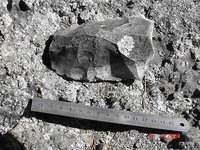
ABORIGINAL SETTLEMENT
The last 25 years have seen spectacular changes in our knowledge of the area Aboriginal past. White (1976:71) states that changes in dating methods have come about because of regionally oriented research programs and the most durable methods of dating the past, come flakes of stone and stone tools types as they change over time.
By distinguishing certain features of stone tools that are common to all sites, dating can be achieved within a rough estimate. The heavy core and flake scrapers (50,000-10,000 years ago) of the “Australian Core Tool and Scraper Tradition” have been associated with making wooden tools such as boomerangs, spears, clubs and throwing sticks. Tools of the newer industries (10,000-5,000 years ago) are relatively small in size and are defined by shape as points, adzes and backed (blunted) blades and are known as the “Small Tool and Scraper Tradition”. These smaller tools are found in conjunction with chisels and axes. The oldest examples of these stone tools come from the New England region (Binns & McBryde 1969, 1972, McBryde 1974 and McCarthy 1979). There was a further change in technology (1,000-400 years ago) with a loss of some items from the range (backed blades and finely retouched [resharpened] blades) were replaced with simple flakes, bipolar pieces and ground edge axes and a greater use of shell, bone and glass for toolmaking (White 1976:76).
ANAIWAN COUNTRY
Tindale (1974:115) gives a definition of the Australian Aboriginal tribes, which have five markers:
1. they inhabit and claim a definite area of country
2. use a dialect or language peculiar to themselves
3. possess a distinctive name
4. have customs and laws differing in some measure from those practiced by their neighbours
5. possess beliefs and ceremonies differing from those held or performed by others.
Hoddinott (1977:52-55) classifies the language as Nganyaywana. He states that this language is now extinct but was formerly spoken in an area from Moonbi in the south to Guyra in the north. The language is unique to the area and has little or no relationship to other Australian Aboriginal languages. From some of the words that have been recorded by researchers, the language has roots that relate to neighbouring areas populated by Daingatti people but that the language diverged many thousands of years ago. Hudson 1996:39, Godwin 1990:381 state that the Anaiwan group living in the Tablelands had ancestors in common with the eastern Daingatti people, but at some stage they broke with the Daingatti and all other neighbouring groups so totally that their language diverged. At some later time they re-established a close social interrelationship with their western neighbours, the Gamilaroi sharing aspects of social organisation and during this contact, the language changed to reflect aspects of the Gamilaroi dialect.
Compared to the surrounding tribal groups:
Gamilaroi – 75,400 sq km – one of the largest in the state
Daingatti - 9,100 sq km
Anaiwan - 8,300 sq km
Weraerai - 4,100 sq km
Bundjalung - 2,300 sq km
Banbai - 2,300 sq km
Ngarabal - 1,000 sq km
Average size in the Tablelands – 5,420 sq km, which relates to climatic and environmental restraints and isolation/altitude for sustainable living areas.
Photo: Burial site
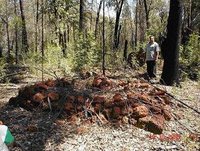
EUROPEAN ARRIVAL
The New England area was investigated in 1818 when Surveyor-General John Oxley explored the area. Alan Cunningham passed through the area in 1825, Charles Sturt in 1828 and Thomas Mitchell in 1831. The first of the settlers who arrived in the Armidale area of New England was Henry Dangar in 1833, whilst working for The Australian Agricultural Company to develop the wool and coal industries (Hudson 2004:4).
In 1832, Hamilton Sempill settled on the Apsley River and named his holding “Wolka” (now Walcha) and Edward Cory settled east of Uralla in 1833 on Salisbury Waters calling his run “Gostwyck”. In 1835 Henry Dangar bought him out, when word of the New England’s productivity for wool growing had spread, and the area was then settled by Henry Dumaresq in 1834, William Dumaresq in 1835 and other settlers who selected land across the New England. These settlers included McDougall, Campbell, Macintyre, Clerk, King, the Everett brothers, Duval, Innes and others who are remembered by present-day places such as Mt Duval, “Clerkness”, Macintyre River, Glen Innes, Land of the Beardies (from Duval and Everett), Beardy Street and River (Hudson 2004:4).
In 1845 Commissioner George Macdonald reported that numbers of Aboriginal people in the New England numbered about 600 men, women and children but stated that because of their “wandering, disunited and unsettled habits, it is impossible to estimate their numbers with any truth”. He also reported that there was a decrease in numbers since 1840 due to disease, their means of subsistence had diminished to a considerable extent because of the arrival of 500,000 sheep onto the Tablelands which had reduced the numbers of macropods – their staple food.
The Aboriginal people were seen as unwanted nuisances standing in the way of European development and economic progress (Macdonald 1845).
In 1851, Commissioner Massie reported that
“… a reserve for use by Aborigines of 350 acres had been put aside, which contained good cultivation ground, good water and every essential requisite for the permanent location of the Aborigines, should they feel disposed to forget their migratory habits” (Massie 1851).
Campbell (1978:6) states that in 1842 there was a cessation of the violence between Aborigines and settlers in the New England. He states that this was due to the change in white population numbers due to the termination of transportation and the assignment system of convicts working for the bushman-managers of the pastoral runs. The usual bushman-manager was being replaced by the wealthier educated squatter, and the census figures confirm this, with a total white population of 2,231 and about 1/3 were convicts and by 1851, this group had dropped to 1/6 of the population.
Walker (1963:141) states that in 1839 Commissioner Macdonald set up his camp on an extensive open plain, well watered and sheltered and situated contiguously to the squatters on Salisbury Court (Uralla), Gostwyck (Uralla), Saumarez (Armidale) and Tilbuster (Armidale). Macdonald named his campsite “Armidale” after his English estate.
Armidale had always been the largest settlement in the Tablelands, which received the first post office in 1843, court of petty session in 1846 and chief constable in 1847 and was the first town to be incorporated as a municipality in 1863 (Walker 1963:141).
Gardner (1852:78) describes country unfit for sheep farming. These places are referred to as the hilly country where box trees are found growing on the slopes and tops of hills. The riverine flats were chosen by settlers to build their homes and sheds. Hudson et al (2003:23) states that the remains of buildings from the first European settlement of the area may reflect British layout and style. Housing began with pitching a tent, followed by wattle and daub, pisé, and simple slab, bark and shingle dwellings or log cabins. With the arrival of sheets of iron and glass, more elaborate structures using brick or stone were constructed. Fittings and fixtures give indications of sophistication of plumbing (baths, indoor toilets, laundries [chip heaters, coppers], early hand operated washing machines, light fittings [carbide gas, generators, 32v electricity]).
CHINESE ARRIVAL
After people of European extraction had settled the area, the white population jealously guarded the area from other ethnic groups. The Armidale Express of 29th August 1857 reported on the mass migration of Chinese people (called Chinamen) during the gold rush period. Claiming that between 40,000 and 50,000 Chinese people were present in Victoria alone and reported again (16th September 1857) that about 60 Chinese people had arrived at the Rocky River goldfields from Victoria. The reporter stated:
“Squatters may not be able to do without pig-tailed cooks and shepherds, or storekeepers without the custom of a legion of Celestials, without dwelling upon the vices they introduce to the colony – leprosy. I would protest against their race, having low mental and bodily powers and half-savage habits, utterly unfit for assimilating with a nation of such a boasted degree of civilisation as our own”.
Smailes and Molyneux (1963:206) report on the state of settlement by 1900 having been broken up from the early pastoral runs by the Robertson Land Act of 1861. This Act brought about a confused pattern of free selection, rapid sales, land dummying and quick turnover of land blocks allowed a new crop of larger holdings owned by wealthier men than the average selector.
Land once deemed to be unfit for pastoral use was now taken up by selectors and areas within town boundaries that had once been designated Aboriginal reserve had been reclaimed for urban development and the incumbent Indigenous inhabitants were again relocated onto less usable or remote areas.
Photo: Stone Axes, knife and flakes
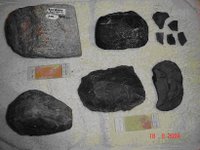
ETHNOGRAPHIC INFORMATION
McBryde (1978:1) states that the only ethnographic source material available for this area are the records, diaries and letters of the early settlers. The information on Aboriginal life and culture is often fragmentary and contradictory and requires much critical sifting, often revealing more about the thoughts of nineteenth century Europeans than of Aboriginal culture. McBryde refers to literature describing the use of stone axes to catch possums and Wyndham (1889:37) recalls a ceremonial gathering on the western fall of the Tablelands where four tribes were present.
Mathews (1896:135) states that ceremonies were of great importance, providing a connection between groups – Daingatti Keeparra (sic) and Gamilaroi Bora (sic) ceremonies. Wyndham (1889:37) states that the last Boora (sic), an initiation of young men, was held on the western fall of New England. Both men and women attended the ceremony but each had their own special areas after the initial meeting of the groups.
Hudson’s (1976) research of this area has located an initiation site near Uralla. This site consists of a stone structure (one side has collapsed), a single stone tool grinding (sharpening) groove and a rock enclosure where the start of the initiation ceremony took place. This site indicates that it was used by both men and women, but as the ceremony progressed, the men left the site and walked approximately 7 km to the bora ground she located west of the initiation site.
Photo: Stone Axe Grinding site
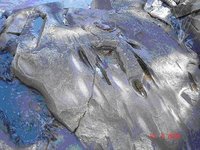
STONE RESOURCES
The surviving relics associated with Aboriginal campsites include seed grinding and axes sharpening grooves in rock slabs, cooking areas, and scatters containing various stone artefacts. Stone artefacts may be found as grave goods, especially axes, knives, seed grinders and other specialised tools. Stones were sometimes used to cover graves and traces of ochre may be found on the stones, which served as grave markers. In the New England area, stones maybe found as stone arrangements. They vary in form ranging from simple cairns to complex groupings of stone circles, single lines, corridors or other designs. They are sometimes found close to water or ochre sources. There is not a lot known about stone arrangements, possibly because Aboriginal people are reluctant to reveal their meaning. Tree falls can cause groups of rocks to resemble circles and stone arrangements made by non-Aboriginal people as survey or boundary markers can be confused with Aboriginal arrangements (James & Conyers 1995:53).
Stone is very durable and stone tools have the capacity to remain in sites long after wood, charcoal, bone and plant remains have disappeared (Wilson 1995). Modified stone is identified as an artefact if it has at least three of the following attributes:
1. positive or negative ringcrack
2. positive or negative bulb of applied force
3. eraillure scar in position beneath the platform
4. definite remnants of flake scars (dorsal scars and ridges)
5. fracture marks such as lines, concentric undulations and point of force (PFA) scarring
Artefacts found in sites are usually flakes, cores, retouched (resharpened) tools, flaked pieces (amorphous pieces that do not have the attributes of a flakes but are found in conjunction with them) and debitage (pieces that break off during the reduction process).
Flaked tools are made from isotropic raw materials, that is they have the same breaking properties in all directions. These materials include chert (flint and jasper), chalcedony (agate and opal), quartz, quartzite, petrified wood, silcrete, mudstone, tuff, argillite and hornfels. These materials are all high in silica. Stone tools made of anisotropic materials, those that do not flake well but fracture along bedding planes, were used for making axes, chisels, wedges and grindstones. These materials include tuff, shale, andesite, slate, granite, adamellite, amphibolite, sandstone, greywacke and some basalts (Wilson 1994).
Photo: Art site in rock Overhang
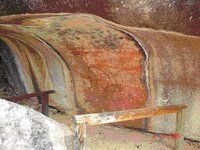
BIBLIOGRAPHY
Armidale Express. Publications 29th August and 16th September 1857.
Beck, W., Somerville, M., Duley, J. & Kippen, K. 2003. An Assessment of the Cultural Significance of the Mt. Yarrowyck Nature Reserve. Unpublished report to NPWS and Aboriginal Communities of the Region. UNE, Armidale.
Binns, R. & McBryde, I. 1972 A petrological Analysis of Ground Edge Artefacts from Northern New South Wales. AIAS, Canberra.
Bowdler, S. 1984. Archaeological significance as a mutable quality. In Sullivan, S. & Bowdler, S. (eds.) Site Surveys and Significance Assessments in Australian Archaeology. Dept. of Prehistory, RSPacS, ANU, Canberra.
Bowdler, S. & Coleman, J. 1981. Aboriginal People o the New England Tablelands: ethnohistory and archaeology in Armidale and District Historical Society Journal and Proceedings. No. 24 March 1981.
Campbell, V.M. 1978. Settlers and Aborigines: the pattern of contact on the New England Tableland. In McBryde, I. (ed). Records f Times Past: Ethnohistorical Essays on the Culture and Ecology of the New England Tribes. AIAS, Canberra. pp 5-16.
Connah, G. Davidson, I. & Rowland, M. 1997. Prehistoric settlement in Lea, Pigram and Greenwood (Eds). An Atlas of New England. Vols. 1 & 2 Map and The Commentaries. Dept. of Geography, University of New England pp 47-70.
Davidson, I. 1982. Archaeology of the New England tablelands: a preliminary report. Armidale & District Historical society. Vol. 15:44-46.
Gardiner, E. 1998. Terrible Vale: no time like the past. DSAMC Education, South Tamworth.
Gardner, W. 1852. Productions and resources of the northern and western districts of New South Wales. Unpublished manuscript, Mitchell Library, Sydney.
Godwin, L. 1983. Archaeological site surveys on the Eastern Margin of the New England Tablelands. Australian Archaeology 17:38-47.
Godwin, L. 1990. Inside Information: settlement and alliance in the late Holocene of Northeastern New South Wales. Unpublished PhD. Thesis, UNE, Armidale.
Hudson, S. 2004 The Business Plan – Armidale Aboriginal Cultural Centre & Keeping Place. Unpublished business plan for the ACC & KP, Armidale.
Hudson, S. 1996. Salisbury Axe Quarry: the acquisition, distribution and cross-exchange patterns from a local distribution site. Unpublished Honours thesis, UNE, Armidale.
Hudson, S., Duncan, L., Kim, M., McKenzie, P., Townsend, L., & Hudson, C. 2003 An Archaeological Survey of Southern New England Landcare Area.
Unpublished report for SNELCC, Armidale.
Hudson, S., Duncan, L., Duncan, W. & McKenzie, P. 2004. Survey of Lot 8 Dangarsleigh Road, Armidale. Unpublished report for Hawkins Hook and Associates, Armidale.
Kerr, J. 1990. The Conservation Plan: a guide to the preparation of conservation plans for places of European cultural significance. National Trust of Australia (NSW).
McBryde, I. 1974. Aboriginal History in New England. Sydney University Press.
Macdonald, G.J. 1845. First Report on the New England Aborigines. Governor’s Dispatches, Vol. 40, 1845 ML.A-1229.
Massie, R.G. 1851. Report on New England Aborigines, 1851. Governor’s Despatches Vol. 71, 1852. ML. A-1260.
Mathews, R.H. 1896. The Burbung of the New England Tribes, NSW. Proceedings of the Royal Society of Victoria Vol. IX.
Moratto, M.J. & Kelly, R.E. 1978. Optimising strategies for evaluating archaeological significance. In Advances in Archaeological Method and Theory. 1:1-30.
National Parks and Wildlife (NPWS) Aboriginal Heritage Information Management System database (AHIMS). Sydney.
Oxley, J. 1818. Extracts from Oxley’s Journal.
Smailes, P.J. & Molyneux, J.K. 1965. The Evolution of an Australian Rural Settlement Pattern: Southern New England, NSW. In the Institute of British Geographers. Reprinted from Transactions and Papers, 1965. Publication No. 36. Fryer Library, UQ, St. Lucia.
Sutton, S. 1989. Results of a survey for Aboriginal sites in the city of Armidale. Report to the Council of Armidale.
Tindale, N.B. 1974. Aboriginal Tribes of Australia. University of California Press, Berkeley.
Walker, R.B. 1963. The Economic Development of New England in the Nineteenth Century. In Warner, R.F. New England Essays. UNE, Armidale.
Wyndham, W.T. 1889. The Aborigines of Australia (Ucumble (sic) Tribe of western New England. The Royal Society of NSW. Vol.XXIII.
Anyway ... getting to the point ... I recently invited Sue to prepare and send me an article for publishing on my blogsite ... and I'm delighted that she has accepted my invitation to contribute. What follows is an illuminating article that Sue wrote in 2004 that will give readers an insight into Aboriginal land use in the Armidale region of New South Wales. Several of Sue's own photographs have also been included as well. Oh ... whilst the article has been provided to me without charge please remember that Sue is the author and holds the copyright to the content.
If you have any questions about the article below or want to get in touch with Sue her contact details are:
Email: sue.hud@bigpond.net.au
Mobile: +61 (0) 412 649 580
ABORIGINAL LAND USE IN THE ARMIDALE AREA
SUZANNE HUDSON, BA (HONS), Dip AF&CC, JP Archaeologist
INTRODUCTION
During 2003 a study of pre-European land use by Aboriginal people – the Anaiwan group of the Armidale area was undertaken. This study involved the movement of Aboriginal people across the environment using stone tools to mark the routes they used to forage, hunt, camp and manufacture both stone and wooden tools.
Places of human habitation, tool procurement sites, scarred and marked trees and places of significance to the inhabitants were used to ‘map’ the area to give an idea of how these people lived in the local environment.
LOCATION
This focuses on the Country of the Anaiwan people, who lived in the area before European arrival. The area forms part of the New England Ranges encompassing eastern and western river systems. Walker (1977:11) describes the region as being dominated by undulating uplands, extending as a tableland belt of varying width, with gently rolling country with shallow valleys terminating in the eastern escarpment east of Walcha.
Photo: Stone tool manufacturing site

GEOLOGY
The geology of the area consists of granites and associated volcanics (greywacke, rhyolite, basalt, diorite). Harrington (1977:31) describes the region as being a difficult communication area as the Peel Fault at Tamworth provides a barrier to easy travel into the area from the south and the escarpment and gorges from the east.
CLIMATE
Climate is the basic element of ecology that affects the study area. Hobbs & Jackson (1977:77) state that the climatic features of the New England area are the result of the effects of distance from the coast and eastern scarp, relief, altitude and latitude which create greater temperature ranges (maximum and minimum), rainfall amounts, and wind patterns.
Some previous researchers (McBryde 1974, Belshaw 1977) state that Aboriginal populations on the Tablelands moved to warmer climates (eastern coastal and western slopes) during the cold winter months, but local research has indicated that there is adequate plant food available during the winter months – for example rusty fig trees (Ficus rubignosa) are in fruit during winter. Experience from living in the study area indicates that cold is relative and if you are accustomed to living in a cold climate, the body adjusts to it.
VEGETATION
Vegetation of the Armidale area falls into three categories:
1. Open woodlands or parkland (as described by the early settlers)
2. Marsh and/or swamplands
3. Grasslands, devoid of tree cover
The survey area can be described as all three categories that of open woodlands or parkland, marshy areas and grasslands. Grasses are predominately native species however introduced species are now covering much of the area, especially since the application of superphosphate fertiliser in the 1960’s. Trees are predominately native species with some new plantings of native species planned for the future.
Sutton (1989:7-8) writes that Aboriginal people of the area used the trees to trap macropods using nets strung between the trees, used the swamps to catch crayfish and dig for yams, roots and hunt water birds and grasslands were maintained by burning to attract large game into the area for hunting.
Photo: Aboriginal stone axe

ABORIGINAL SETTLEMENT
The last 25 years have seen spectacular changes in our knowledge of the area Aboriginal past. White (1976:71) states that changes in dating methods have come about because of regionally oriented research programs and the most durable methods of dating the past, come flakes of stone and stone tools types as they change over time.
By distinguishing certain features of stone tools that are common to all sites, dating can be achieved within a rough estimate. The heavy core and flake scrapers (50,000-10,000 years ago) of the “Australian Core Tool and Scraper Tradition” have been associated with making wooden tools such as boomerangs, spears, clubs and throwing sticks. Tools of the newer industries (10,000-5,000 years ago) are relatively small in size and are defined by shape as points, adzes and backed (blunted) blades and are known as the “Small Tool and Scraper Tradition”. These smaller tools are found in conjunction with chisels and axes. The oldest examples of these stone tools come from the New England region (Binns & McBryde 1969, 1972, McBryde 1974 and McCarthy 1979). There was a further change in technology (1,000-400 years ago) with a loss of some items from the range (backed blades and finely retouched [resharpened] blades) were replaced with simple flakes, bipolar pieces and ground edge axes and a greater use of shell, bone and glass for toolmaking (White 1976:76).
ANAIWAN COUNTRY
Tindale (1974:115) gives a definition of the Australian Aboriginal tribes, which have five markers:
1. they inhabit and claim a definite area of country
2. use a dialect or language peculiar to themselves
3. possess a distinctive name
4. have customs and laws differing in some measure from those practiced by their neighbours
5. possess beliefs and ceremonies differing from those held or performed by others.
Hoddinott (1977:52-55) classifies the language as Nganyaywana. He states that this language is now extinct but was formerly spoken in an area from Moonbi in the south to Guyra in the north. The language is unique to the area and has little or no relationship to other Australian Aboriginal languages. From some of the words that have been recorded by researchers, the language has roots that relate to neighbouring areas populated by Daingatti people but that the language diverged many thousands of years ago. Hudson 1996:39, Godwin 1990:381 state that the Anaiwan group living in the Tablelands had ancestors in common with the eastern Daingatti people, but at some stage they broke with the Daingatti and all other neighbouring groups so totally that their language diverged. At some later time they re-established a close social interrelationship with their western neighbours, the Gamilaroi sharing aspects of social organisation and during this contact, the language changed to reflect aspects of the Gamilaroi dialect.
Compared to the surrounding tribal groups:
Gamilaroi – 75,400 sq km – one of the largest in the state
Daingatti - 9,100 sq km
Anaiwan - 8,300 sq km
Weraerai - 4,100 sq km
Bundjalung - 2,300 sq km
Banbai - 2,300 sq km
Ngarabal - 1,000 sq km
Average size in the Tablelands – 5,420 sq km, which relates to climatic and environmental restraints and isolation/altitude for sustainable living areas.
Photo: Burial site
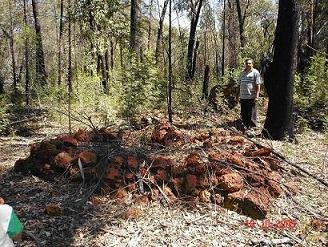
EUROPEAN ARRIVAL
The New England area was investigated in 1818 when Surveyor-General John Oxley explored the area. Alan Cunningham passed through the area in 1825, Charles Sturt in 1828 and Thomas Mitchell in 1831. The first of the settlers who arrived in the Armidale area of New England was Henry Dangar in 1833, whilst working for The Australian Agricultural Company to develop the wool and coal industries (Hudson 2004:4).
In 1832, Hamilton Sempill settled on the Apsley River and named his holding “Wolka” (now Walcha) and Edward Cory settled east of Uralla in 1833 on Salisbury Waters calling his run “Gostwyck”. In 1835 Henry Dangar bought him out, when word of the New England’s productivity for wool growing had spread, and the area was then settled by Henry Dumaresq in 1834, William Dumaresq in 1835 and other settlers who selected land across the New England. These settlers included McDougall, Campbell, Macintyre, Clerk, King, the Everett brothers, Duval, Innes and others who are remembered by present-day places such as Mt Duval, “Clerkness”, Macintyre River, Glen Innes, Land of the Beardies (from Duval and Everett), Beardy Street and River (Hudson 2004:4).
In 1845 Commissioner George Macdonald reported that numbers of Aboriginal people in the New England numbered about 600 men, women and children but stated that because of their “wandering, disunited and unsettled habits, it is impossible to estimate their numbers with any truth”. He also reported that there was a decrease in numbers since 1840 due to disease, their means of subsistence had diminished to a considerable extent because of the arrival of 500,000 sheep onto the Tablelands which had reduced the numbers of macropods – their staple food.
The Aboriginal people were seen as unwanted nuisances standing in the way of European development and economic progress (Macdonald 1845).
In 1851, Commissioner Massie reported that
“… a reserve for use by Aborigines of 350 acres had been put aside, which contained good cultivation ground, good water and every essential requisite for the permanent location of the Aborigines, should they feel disposed to forget their migratory habits” (Massie 1851).
Campbell (1978:6) states that in 1842 there was a cessation of the violence between Aborigines and settlers in the New England. He states that this was due to the change in white population numbers due to the termination of transportation and the assignment system of convicts working for the bushman-managers of the pastoral runs. The usual bushman-manager was being replaced by the wealthier educated squatter, and the census figures confirm this, with a total white population of 2,231 and about 1/3 were convicts and by 1851, this group had dropped to 1/6 of the population.
Walker (1963:141) states that in 1839 Commissioner Macdonald set up his camp on an extensive open plain, well watered and sheltered and situated contiguously to the squatters on Salisbury Court (Uralla), Gostwyck (Uralla), Saumarez (Armidale) and Tilbuster (Armidale). Macdonald named his campsite “Armidale” after his English estate.
Armidale had always been the largest settlement in the Tablelands, which received the first post office in 1843, court of petty session in 1846 and chief constable in 1847 and was the first town to be incorporated as a municipality in 1863 (Walker 1963:141).
Gardner (1852:78) describes country unfit for sheep farming. These places are referred to as the hilly country where box trees are found growing on the slopes and tops of hills. The riverine flats were chosen by settlers to build their homes and sheds. Hudson et al (2003:23) states that the remains of buildings from the first European settlement of the area may reflect British layout and style. Housing began with pitching a tent, followed by wattle and daub, pisé, and simple slab, bark and shingle dwellings or log cabins. With the arrival of sheets of iron and glass, more elaborate structures using brick or stone were constructed. Fittings and fixtures give indications of sophistication of plumbing (baths, indoor toilets, laundries [chip heaters, coppers], early hand operated washing machines, light fittings [carbide gas, generators, 32v electricity]).
CHINESE ARRIVAL
After people of European extraction had settled the area, the white population jealously guarded the area from other ethnic groups. The Armidale Express of 29th August 1857 reported on the mass migration of Chinese people (called Chinamen) during the gold rush period. Claiming that between 40,000 and 50,000 Chinese people were present in Victoria alone and reported again (16th September 1857) that about 60 Chinese people had arrived at the Rocky River goldfields from Victoria. The reporter stated:
“Squatters may not be able to do without pig-tailed cooks and shepherds, or storekeepers without the custom of a legion of Celestials, without dwelling upon the vices they introduce to the colony – leprosy. I would protest against their race, having low mental and bodily powers and half-savage habits, utterly unfit for assimilating with a nation of such a boasted degree of civilisation as our own”.
Smailes and Molyneux (1963:206) report on the state of settlement by 1900 having been broken up from the early pastoral runs by the Robertson Land Act of 1861. This Act brought about a confused pattern of free selection, rapid sales, land dummying and quick turnover of land blocks allowed a new crop of larger holdings owned by wealthier men than the average selector.
Land once deemed to be unfit for pastoral use was now taken up by selectors and areas within town boundaries that had once been designated Aboriginal reserve had been reclaimed for urban development and the incumbent Indigenous inhabitants were again relocated onto less usable or remote areas.
Photo: Stone Axes, knife and flakes
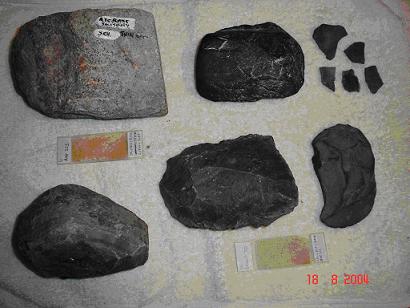
ETHNOGRAPHIC INFORMATION
McBryde (1978:1) states that the only ethnographic source material available for this area are the records, diaries and letters of the early settlers. The information on Aboriginal life and culture is often fragmentary and contradictory and requires much critical sifting, often revealing more about the thoughts of nineteenth century Europeans than of Aboriginal culture. McBryde refers to literature describing the use of stone axes to catch possums and Wyndham (1889:37) recalls a ceremonial gathering on the western fall of the Tablelands where four tribes were present.
Mathews (1896:135) states that ceremonies were of great importance, providing a connection between groups – Daingatti Keeparra (sic) and Gamilaroi Bora (sic) ceremonies. Wyndham (1889:37) states that the last Boora (sic), an initiation of young men, was held on the western fall of New England. Both men and women attended the ceremony but each had their own special areas after the initial meeting of the groups.
Hudson’s (1976) research of this area has located an initiation site near Uralla. This site consists of a stone structure (one side has collapsed), a single stone tool grinding (sharpening) groove and a rock enclosure where the start of the initiation ceremony took place. This site indicates that it was used by both men and women, but as the ceremony progressed, the men left the site and walked approximately 7 km to the bora ground she located west of the initiation site.
Photo: Stone Axe Grinding site

STONE RESOURCES
The surviving relics associated with Aboriginal campsites include seed grinding and axes sharpening grooves in rock slabs, cooking areas, and scatters containing various stone artefacts. Stone artefacts may be found as grave goods, especially axes, knives, seed grinders and other specialised tools. Stones were sometimes used to cover graves and traces of ochre may be found on the stones, which served as grave markers. In the New England area, stones maybe found as stone arrangements. They vary in form ranging from simple cairns to complex groupings of stone circles, single lines, corridors or other designs. They are sometimes found close to water or ochre sources. There is not a lot known about stone arrangements, possibly because Aboriginal people are reluctant to reveal their meaning. Tree falls can cause groups of rocks to resemble circles and stone arrangements made by non-Aboriginal people as survey or boundary markers can be confused with Aboriginal arrangements (James & Conyers 1995:53).
Stone is very durable and stone tools have the capacity to remain in sites long after wood, charcoal, bone and plant remains have disappeared (Wilson 1995). Modified stone is identified as an artefact if it has at least three of the following attributes:
1. positive or negative ringcrack
2. positive or negative bulb of applied force
3. eraillure scar in position beneath the platform
4. definite remnants of flake scars (dorsal scars and ridges)
5. fracture marks such as lines, concentric undulations and point of force (PFA) scarring
Artefacts found in sites are usually flakes, cores, retouched (resharpened) tools, flaked pieces (amorphous pieces that do not have the attributes of a flakes but are found in conjunction with them) and debitage (pieces that break off during the reduction process).
Flaked tools are made from isotropic raw materials, that is they have the same breaking properties in all directions. These materials include chert (flint and jasper), chalcedony (agate and opal), quartz, quartzite, petrified wood, silcrete, mudstone, tuff, argillite and hornfels. These materials are all high in silica. Stone tools made of anisotropic materials, those that do not flake well but fracture along bedding planes, were used for making axes, chisels, wedges and grindstones. These materials include tuff, shale, andesite, slate, granite, adamellite, amphibolite, sandstone, greywacke and some basalts (Wilson 1994).
Photo: Art site in rock Overhang

BIBLIOGRAPHY
Armidale Express. Publications 29th August and 16th September 1857.
Beck, W., Somerville, M., Duley, J. & Kippen, K. 2003. An Assessment of the Cultural Significance of the Mt. Yarrowyck Nature Reserve. Unpublished report to NPWS and Aboriginal Communities of the Region. UNE, Armidale.
Binns, R. & McBryde, I. 1972 A petrological Analysis of Ground Edge Artefacts from Northern New South Wales. AIAS, Canberra.
Bowdler, S. 1984. Archaeological significance as a mutable quality. In Sullivan, S. & Bowdler, S. (eds.) Site Surveys and Significance Assessments in Australian Archaeology. Dept. of Prehistory, RSPacS, ANU, Canberra.
Bowdler, S. & Coleman, J. 1981. Aboriginal People o the New England Tablelands: ethnohistory and archaeology in Armidale and District Historical Society Journal and Proceedings. No. 24 March 1981.
Campbell, V.M. 1978. Settlers and Aborigines: the pattern of contact on the New England Tableland. In McBryde, I. (ed). Records f Times Past: Ethnohistorical Essays on the Culture and Ecology of the New England Tribes. AIAS, Canberra. pp 5-16.
Connah, G. Davidson, I. & Rowland, M. 1997. Prehistoric settlement in Lea, Pigram and Greenwood (Eds). An Atlas of New England. Vols. 1 & 2 Map and The Commentaries. Dept. of Geography, University of New England pp 47-70.
Davidson, I. 1982. Archaeology of the New England tablelands: a preliminary report. Armidale & District Historical society. Vol. 15:44-46.
Gardiner, E. 1998. Terrible Vale: no time like the past. DSAMC Education, South Tamworth.
Gardner, W. 1852. Productions and resources of the northern and western districts of New South Wales. Unpublished manuscript, Mitchell Library, Sydney.
Godwin, L. 1983. Archaeological site surveys on the Eastern Margin of the New England Tablelands. Australian Archaeology 17:38-47.
Godwin, L. 1990. Inside Information: settlement and alliance in the late Holocene of Northeastern New South Wales. Unpublished PhD. Thesis, UNE, Armidale.
Hudson, S. 2004 The Business Plan – Armidale Aboriginal Cultural Centre & Keeping Place. Unpublished business plan for the ACC & KP, Armidale.
Hudson, S. 1996. Salisbury Axe Quarry: the acquisition, distribution and cross-exchange patterns from a local distribution site. Unpublished Honours thesis, UNE, Armidale.
Hudson, S., Duncan, L., Kim, M., McKenzie, P., Townsend, L., & Hudson, C. 2003 An Archaeological Survey of Southern New England Landcare Area.
Unpublished report for SNELCC, Armidale.
Hudson, S., Duncan, L., Duncan, W. & McKenzie, P. 2004. Survey of Lot 8 Dangarsleigh Road, Armidale. Unpublished report for Hawkins Hook and Associates, Armidale.
Kerr, J. 1990. The Conservation Plan: a guide to the preparation of conservation plans for places of European cultural significance. National Trust of Australia (NSW).
McBryde, I. 1974. Aboriginal History in New England. Sydney University Press.
Macdonald, G.J. 1845. First Report on the New England Aborigines. Governor’s Dispatches, Vol. 40, 1845 ML.A-1229.
Massie, R.G. 1851. Report on New England Aborigines, 1851. Governor’s Despatches Vol. 71, 1852. ML. A-1260.
Mathews, R.H. 1896. The Burbung of the New England Tribes, NSW. Proceedings of the Royal Society of Victoria Vol. IX.
Moratto, M.J. & Kelly, R.E. 1978. Optimising strategies for evaluating archaeological significance. In Advances in Archaeological Method and Theory. 1:1-30.
National Parks and Wildlife (NPWS) Aboriginal Heritage Information Management System database (AHIMS). Sydney.
Oxley, J. 1818. Extracts from Oxley’s Journal.
Smailes, P.J. & Molyneux, J.K. 1965. The Evolution of an Australian Rural Settlement Pattern: Southern New England, NSW. In the Institute of British Geographers. Reprinted from Transactions and Papers, 1965. Publication No. 36. Fryer Library, UQ, St. Lucia.
Sutton, S. 1989. Results of a survey for Aboriginal sites in the city of Armidale. Report to the Council of Armidale.
Tindale, N.B. 1974. Aboriginal Tribes of Australia. University of California Press, Berkeley.
Walker, R.B. 1963. The Economic Development of New England in the Nineteenth Century. In Warner, R.F. New England Essays. UNE, Armidale.
Wyndham, W.T. 1889. The Aborigines of Australia (Ucumble (sic) Tribe of western New England. The Royal Society of NSW. Vol.XXIII.
Subscribe to:
Posts (Atom)